
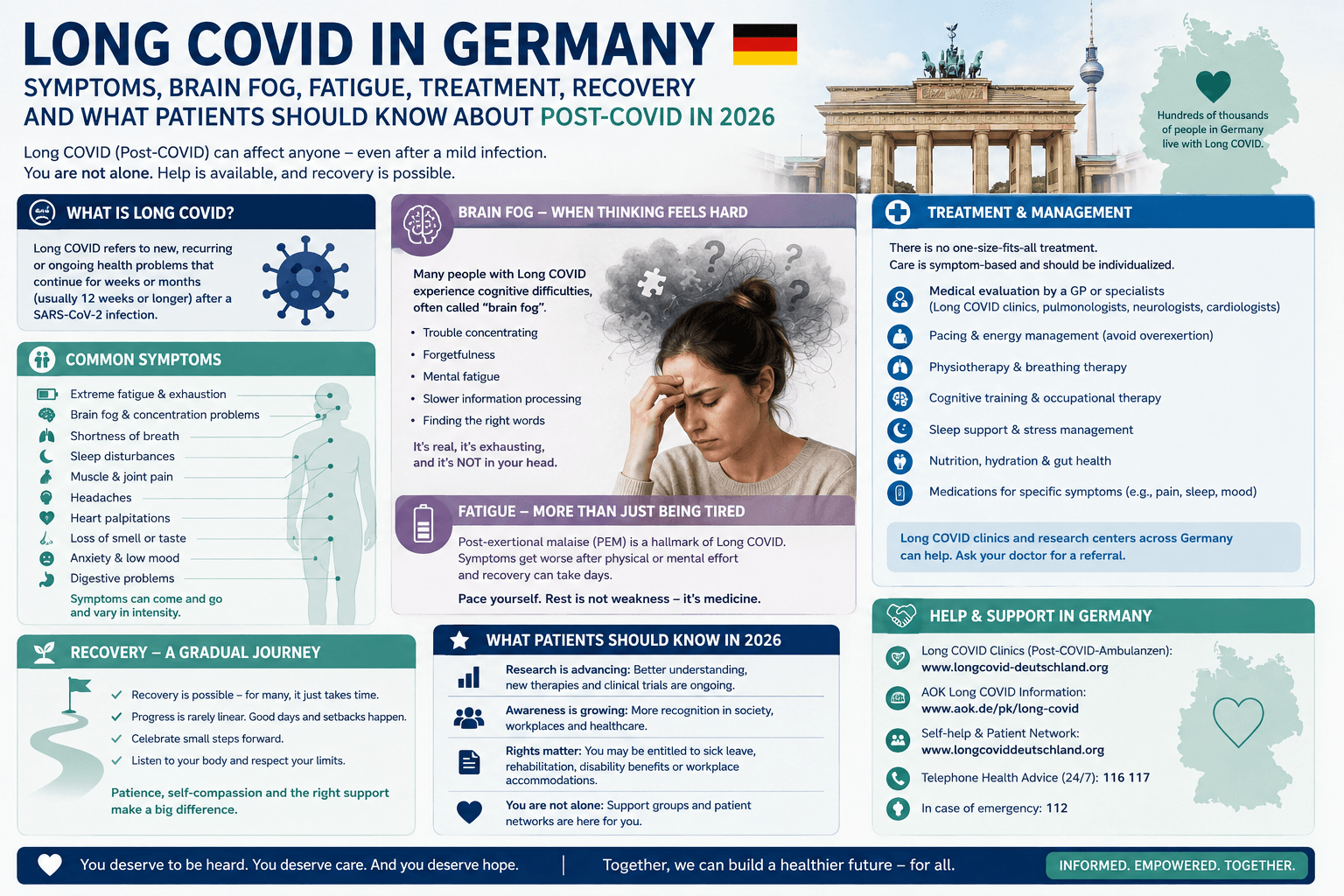
Long COVID remains an important health issue in Germany, even years after the acute phase of the COVID-19 pandemic. For some people, a COVID-19 infection ends after a few days or weeks. For others, symptoms can continue, return, or appear after the initial infection has seemingly passed.
Persistent fatigue, shortness of breath, brain fog, sleep problems, headaches, muscle pain and reduced ability to exercise can make everyday life unexpectedly difficult.
But what exactly is Long COVID? How is it recognized in Germany? What symptoms should people watch for, and what treatment options are currently available?
This guide explains what we know about Long COVID and Post-COVID in Germany in 2026, based on information from German public-health authorities and the World Health Organization.
Medical disclaimer: This article is for general information and does not replace an examination, diagnosis or treatment plan from a qualified healthcare professional.
What Is Long COVID?
Long COVID, also called post-COVID-19 condition or Post-COVID-Syndrom, describes health problems that continue or develop after a SARS-CoV-2 infection.
According to the World Health Organization, post-COVID-19 condition generally occurs around three months after the initial infection, with symptoms lasting for at least two months and not being explained by another diagnosis. Symptoms can persist from the original illness or develop after a period of recovery.
Germany’s Robert Koch Institute similarly describes Long COVID as longer-term health impairments following COVID-19.
One of the most challenging aspects is that Long COVID does not look the same in every person.
Two people can have had COVID-19 at roughly the same time but experience completely different long-term effects.
For one person, the main problem may be exhaustion. Another may struggle with concentration, dizziness, breathing difficulties or sleep.
That variability is one reason Long COVID can be difficult to recognize and manage.
How Common Is Long COVID?
The exact number of people affected remains difficult to determine because studies use different definitions, populations and follow-up periods.
WHO’s more recent estimates suggest that approximately 6 in 100 people who have had COVID-19 develop post-COVID-19 condition, although estimates vary considerably between studies and periods of the pandemic.
Earlier WHO estimates were higher, with approximately 10–20% of people infected with SARS-CoV-2 developing prolonged symptoms. The difference highlights an important point: there is no single universal percentage that accurately describes every population or COVID-19 variant.
For Germany, this means the overall burden cannot simply be reduced to one number.
The more important question for an individual is whether persistent symptoms are interfering with normal life.
Common Long COVID Symptoms
Long COVID can affect multiple parts of the body.
Some of the most frequently reported symptoms include:
- Persistent fatigue or exhaustion
- Shortness of breath
- Reduced physical stamina
- Brain fog
- Problems with memory or concentration
- Sleep disturbances
- Headaches
- Muscle or joint pain
- Persistent cough
- Chest discomfort or pain
- Dizziness
- Changes in smell or taste
- Anxiety or depression
- Heart palpitations
- Exercise intolerance
WHO notes that more than 200 symptoms have been reported in connection with post-COVID-19 condition.
This does not mean that someone experiencing one of these symptoms automatically has Long COVID.
Many of these symptoms can have numerous other causes, which is why proper medical assessment matters.
What Does Long COVID Brain Fog Feel Like?
“Brain fog” is one of the terms frequently used by people living with Long COVID.
It is not a formal diagnosis by itself. Instead, people may use the term to describe problems such as:
- Difficulty concentrating
- Forgetfulness
- Slower thinking
- Difficulty finding words
- Trouble following conversations
- Feeling mentally exhausted after simple tasks
- Difficulty switching between tasks
Someone may feel mentally capable but find that activities requiring sustained concentration suddenly take much more effort.
This can become particularly frustrating at work or university.
A person might be able to perform a task one day but struggle with the same task after a period of poor sleep, physical exertion or worsening symptoms.
Can Long COVID Affect Young and Otherwise Healthy People?
Yes.
Long COVID is not limited to older adults or people who were hospitalized with severe COVID-19.
WHO states that anyone who has been infected with SARS-CoV-2 can develop post-COVID-19 condition, although some groups appear to have higher risks.
This is an important distinction because a mild initial infection does not necessarily guarantee a completely symptom-free recovery.
At the same time, having persistent tiredness or another symptom after COVID-19 does not automatically mean that a person has Long COVID.
Other medical explanations need to be considered.
Why Does Long COVID Happen?
There is no single confirmed explanation that accounts for every case.
Researchers are investigating several possible mechanisms, including:
- Persistent effects of the infection
- Changes in immune-system activity
- Inflammation
- Autoimmune processes
- Effects on blood vessels
- Nervous-system changes
- Problems involving multiple organ systems
WHO reports evidence under investigation involving persistent SARS-CoV-2 material, altered immune responses, autoimmunity and microvascular changes, among other possible mechanisms.
However, research is still developing.
This is why claims that Long COVID has already been completely explained — or that one supplement, drug or lifestyle change can “cure” it — should be treated cautiously.
Can You Get Long COVID After a Mild COVID Infection?
Yes.
People who were never hospitalized can still develop prolonged symptoms.
However, risk is not identical for everyone. WHO identifies factors associated with increased risk, including older age, smoking, overweight or obesity, certain pre-existing health problems, repeated infections and severe COVID-19 requiring hospitalization or intensive care.
The important takeaway is simple:
The severity of the original infection is relevant, but it does not tell the whole story.
Long COVID Treatment in Germany
One of the biggest misconceptions about Long COVID is that there is a single medication that treats the condition itself.
Currently, there is no universally established treatment that cures Long COVID.
Germany’s federal health information portal states that treatment currently focuses on relieving symptoms, improving quality of life and helping patients regain function and stamina. Early and targeted medical advice is considered important.
Treatment therefore depends heavily on the person’s symptoms.
Depending on the situation, healthcare professionals may consider:
- Symptom management
- Medical investigations to rule out other conditions
- Rehabilitation
- Physical or occupational support
- Cognitive support
- Sleep management
- Psychological support when appropriate
- Treatment of specific medical problems identified during assessment
The goal is not simply to tell someone to “exercise more.”
For some patients, particularly those experiencing post-exertional malaise (PEM), pushing through severe symptoms can make their condition worse.
WHO recommends individualized management and emphasizes education, rest, energy conservation and appropriate responses to symptom flare-ups.
What Is Post-Exertional Malaise?
Post-exertional malaise, commonly shortened to PEM, is an important concept when discussing Long COVID.
A person may feel relatively stable and then experience a significant worsening of symptoms after physical, mental or emotional activity.
The reaction may not always happen immediately.
For example, someone might go for a longer walk than usual and feel reasonably fine at first. Later that day or the following day, they may experience substantially increased fatigue, cognitive problems, dizziness or other symptoms.
This is one reason generic advice such as “just exercise more” can be inappropriate for some people with Long COVID.
Activity should be individualized and discussed with healthcare professionals when symptoms are significant.
Long COVID and Work in Germany
For many patients, the most difficult consequence is not a single symptom.
It is losing the ability to do things they previously considered normal.
Working a full day, commuting, looking after children, shopping or even concentrating on a computer screen can become difficult.
WHO notes that post-COVID-19 condition can interfere with everyday activities, work and social participation.
This creates a wider social and economic issue.
A person may technically be able to work but no longer be able to maintain the same workload.
For employers and employees, understanding fluctuating symptoms can therefore be important.
Long COVID is not necessarily visible from the outside.
Someone can look completely healthy while struggling significantly with fatigue, cognitive symptoms or exercise intolerance.
When Should You See a Doctor?
Persistent symptoms after COVID-19 deserve medical attention, particularly when they interfere with daily life.
Consider speaking with a healthcare professional if you experience ongoing or worsening:
- Shortness of breath
- Chest pain
- Severe fatigue
- Cognitive difficulties
- Dizziness
- Heart palpitations
- Sleep problems
- Significant exercise intolerance
- Symptoms that repeatedly return after activity
A doctor can evaluate the symptoms and determine whether another condition could explain them.
Emergency symptoms such as severe breathing difficulty, severe chest pain, fainting or other sudden serious symptoms require urgent medical evaluation rather than waiting for a Long COVID appointment.
Is Long COVID Permanent?
Not necessarily.
The course varies substantially between individuals.
Some people gradually improve, while others experience symptoms for much longer. Symptoms can also fluctuate, improve and then return.
WHO’s 2025 information indicates that symptoms generally improve over time for many people, with global estimates suggesting a typical improvement period of roughly four to nine months, although some people continue to experience symptoms at 12 months or longer.
This means that a Long COVID diagnosis should not automatically be interpreted as a prediction of lifelong disability.
At the same time, persistent symptoms should not be dismissed simply because recovery can occur.
5 Long COVID Myths You Should Stop Believing
Myth 1: “Long COVID is just being tired.”
Reality: Fatigue is common, but Long COVID can involve respiratory, neurological, cardiovascular, cognitive, sleep and other symptoms.
Myth 2: “You only get Long COVID if you were hospitalized.”
Reality: People with mild initial infections can also develop post-COVID symptoms.
Myth 3: “There is one medication that cures Long COVID.”
Reality: There is currently no single established cure. Management is individualized and often focuses on specific symptoms and rehabilitation.
Myth 4: “If medical tests are normal, the symptoms aren’t real.”
Reality: Long COVID can involve complex symptoms that do not always have an obvious abnormality on routine testing. Medical evaluation is still important to identify other possible causes.
Myth 5: “Everyone with Long COVID needs intense exercise.”
Reality: Activity needs to be individualized. People experiencing post-exertional malaise may need careful energy management rather than simply increasing exercise.
WHO/Europe specifically addressed misinformation surrounding Long COVID in 2026, highlighting how myths can interfere with diagnosis, care and rehabilitation.
What Can Patients Do at Home?
There is no universal home treatment, but symptom tracking can help.
Consider keeping a simple record of:
- Sleep
- Physical activity
- Mental workload
- Symptoms
- Food and hydration
- Stress
- Possible symptom triggers
- Recovery time after activity
Patterns can sometimes become clearer over several weeks.
Energy conservation can also be useful for people who experience worsening symptoms after exertion. WHO recommends learning to identify triggers, temporarily reducing activity during flare-ups and avoiding immediately returning to previous activity levels before the flare-up has resolved.
Most importantly, avoid treating online anecdotes as medical prescriptions.
What helps one person may not help another.
Long COVID in Germany: What Should We Expect in 2026?
The Long COVID conversation in Germany is moving beyond the question of whether the condition exists.
The bigger questions now involve better diagnosis, individualized treatment, rehabilitation, workplace support and long-term research.
WHO/Europe stated in 2026 that misconceptions about Long COVID continue to affect diagnosis, prevention, care and rehabilitation. It also estimated that more than 36 million people across the WHO European Region may have experienced the condition during the first three years of the pandemic.
For Germany, this means Long COVID remains relevant even though the acute pandemic emergency has passed.
COVID-19 may no longer dominate everyday headlines as it once did, but its long-term consequences have not simply disappeared.
The Bottom Line
Long COVID is a complex post-infectious condition that can affect physical health, cognitive function, mental wellbeing and everyday life.
The most commonly reported symptoms include fatigue, breathlessness and cognitive problems, but the condition can involve a much wider range of symptoms.
There is currently no single treatment that works for everyone.
For people in Germany experiencing persistent symptoms after COVID-19, the most sensible approach is to seek appropriate medical evaluation rather than relying on social-media cures or assuming that the symptoms will simply disappear.
Long COVID is still being researched — and that means our understanding will continue to evolve.
What is clear today is that persistent symptoms deserve to be taken seriously.
Frequently Asked Questions
What is Long COVID called in Germany?
It is commonly referred to as Long COVID, Post-COVID, or Post-COVID-Syndrom.
How long does Long COVID last?
The duration varies. Some people improve within months, while others experience symptoms for a year or longer.
Can Long COVID happen after a mild infection?
Yes. A person does not have to have been hospitalized to develop post-COVID symptoms.
Is there a cure for Long COVID?
There is currently no single proven cure for Long COVID. Treatment is generally individualized and focused on symptoms, function and quality of life.
What are the most common Long COVID symptoms?
Fatigue, shortness of breath and cognitive difficulties are among the most commonly reported symptoms. Other symptoms can include headaches, sleep problems, muscle pain, chest discomfort and changes in smell or taste.
Should I exercise if I have Long COVID?
It depends on your symptoms. People with post-exertional malaise may need careful activity and energy management rather than simply increasing exercise. Discuss persistent or severe symptoms with a healthcare professional.
LumeChronos Health Disclaimer:
“This article provides general educational information and is not medical advice. Always consult a qualified healthcare professional for diagnosis, treatment or concerns about persistent symptoms after COVID-19“.

One thought on “Long COVID in Germany: Symptoms, Causes, Treatment and What Patients Should Know in 2026”