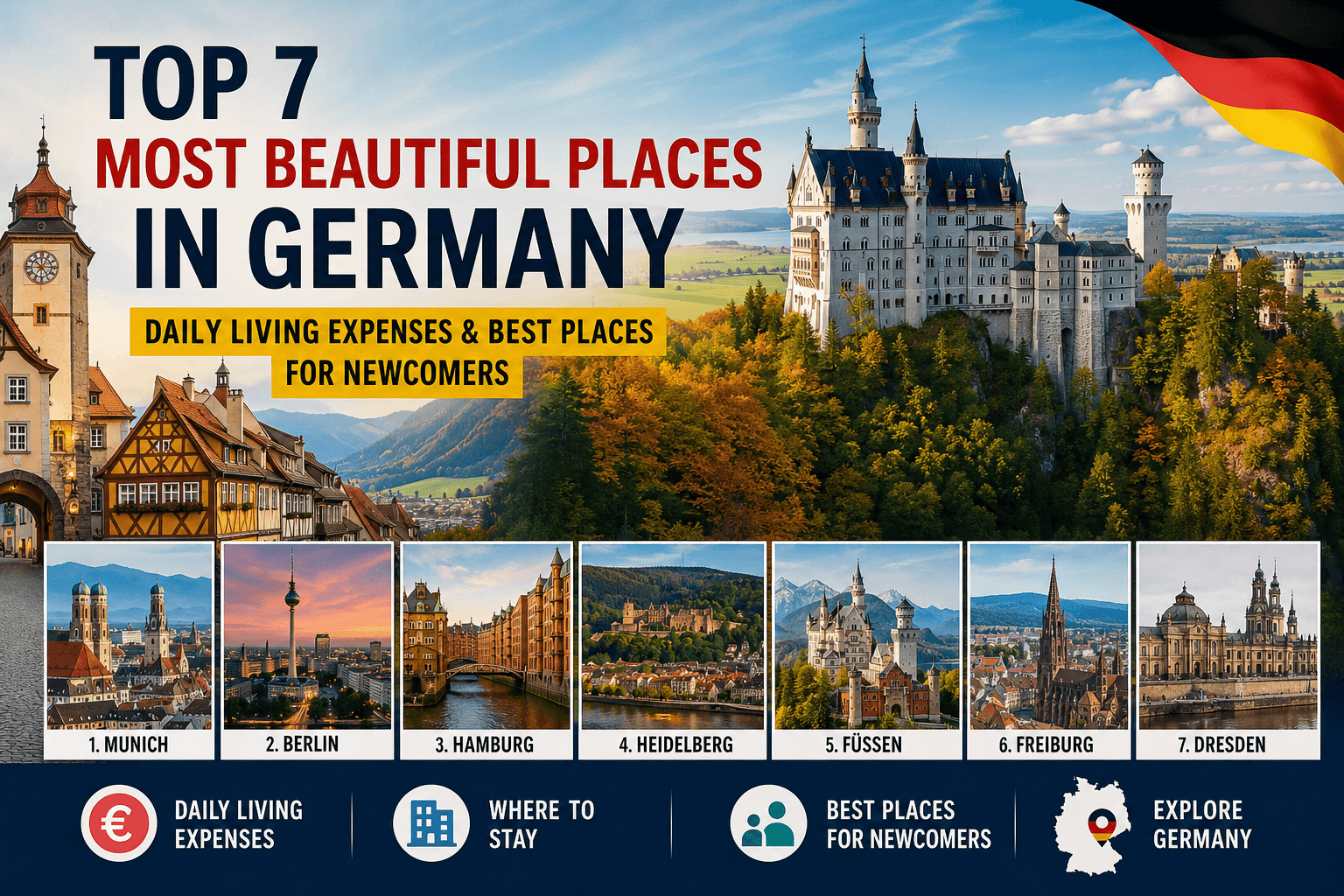
Beautiful Places in Germany
This guide highlights Germany’s top 7 scenic cities to live in – Berlin, Munich, Hamburg, Frankfurt, Cologne, Dresden, and Heidelberg. For each, we describe key attractions, the best season to visit, and why it’s special. We also break down monthly living costs (1 BR rent, utilities, groceries, transport, dining) with approximate ranges (EUR), plus recommended neighborhoods and two lodging options (budget vs. mid-range with links). Practical tips on registering (Anmeldung), transit passes, language, and healthcare are included. A comparative cost table and a timeline of ideal travel months round out the report.
Introduction
Germany offers a wealth of history, culture and natural beauty. From Berlin’s vibrant urban life to the fairytale spires of Heidelberg Castle, each city has a unique appeal. This post explores the Top 7 Most Beautiful Places in Germany for English-speaking newcomers. We cover attractions, local vibe and climate, plus living costs and neighborhoods for expats. (Focus keyword: beautiful places in Germany.)
1. Berlin
Berlin – the dynamic capital – blends imperial monuments and edgy modern culture. Key sights include the Brandenburg Gate, Reichstag and Museum Island, with countless museums and galleries. Lively neighborhoods range from artsy Kreuzberg to elegant Charlottenburg. Berlin’s summer (May–Sept) is ideal for festivals and parks, while winter has famed Christmas markets. It’s beautiful for its grand boulevards and diverse neighborhoods.
- Daily living costs: Rent ~€950–1,650; utilities ~€237–€500; monthly transport ~€60–106; groceries roughly €200–300; dining out (meal ~€10–€15). Total ~€1,500–2,000/month.
- Neighborhoods: Mitte (historic center, close to sights), Kreuzberg (hip, multicultural), Prenzlauer Berg (family-friendly, cafes), Charlottenburg (leafy west, expat favorite).
- Accommodations: Budget: Generator Berlin Mitte Hostel near Alexanderplatz; Mid-range: Motel One Berlin-Alexanderplatz (modern design hotel).
2. Munich
Munich – Bavaria’s capital – is famed for its historic Altstadt (old town), beer gardens and proximity to the Alps. Stroll Marienplatz and the Viktualienmarkt, or visit Nymphenburg Palace. Nearby Neuschwanstein Castle and the Bavarian countryside add fairytale charm. Best visited in late spring to early fall (May–Sept) or during Christmas markets. Munich’s beauty lies in its blend of Alpine views, architecture and parkland (English Garden).
- Daily living costs: Rent ~€1,100–2,000; utilities ~€246–507; monthly transport ~€63; groceries ~€200–300; dining (meal ~€15–€18). Total ~€1,800–2,400/month.
- Neighborhoods: Altstadt/Ludwigsvorstadt (central, walkable), Maxvorstadt (university district, cafes), Schwabing (tree-lined boulevards, parks), Haidhausen/Isarvorstadt (nightlife, trendy).
- Accommodations: Budget: MEININGER Hotel München Hauptbahnhof (hostel-style city-center); Mid-range: Hotel Torbräu (historic downtown hotel).
3. Hamburg
Hamburg – Germany’s port city – is known for its waterways, Brick & Warehouses (Speicherstadt) and the Elbphilharmonie concert hall. The harbor promenade and fish market are must-sees. Summer (June–Aug) offers pleasant weather for boat tours; spring and early fall are also nice. Hamburg’s beauty comes from its mix of canals, green parks (Planten un Blomen) and vibrant Reeperbahn nightlife.
- Daily living costs: Rent ~€800–1,500; utilities ~€198–463; monthly transport ~€61; groceries ~€200–300; dining (meal ~€12–€17). Total ~€1,600–2,200/month.
- Neighborhoods: Altstadt/Neustadt (city center by the Alster lake), St. Pauli (hip harbor area, nightlife), Altona/Ottensen (bohemian, near Elbe), Eimsbüttel (green, residential).
- Accommodations: Budget: a&o Hamburg Hauptbahnhof (hostel near central station); Mid-range: Sir Nikolai Hotel (boutique hotel in city center).
4. Frankfurt
Frankfurt – Germany’s financial hub – surprises with a historic Old Town (Römerberg) under a skyline of skyscrapers. The Museumsufer (Museum Riverbank) and Palmengarten botanical gardens are highlights. Spring to early autumn (May–Sept) brings warm days and river cruises. Frankfurt’s appeal is its modern-city meets old-world mix, plus easy central location.
- Daily living costs: Rent ~€925–1,600; utilities ~€235–€458; monthly transport ~€63; groceries ~€200–€300; dining (meal ~€10–€15). Total ~€1,600–2,200/month.
- Neighborhoods: Westend (upscale parks and grand 19th-c buildings), Nordend (gentrified, leafy streets), Sachsenhausen (south of Main, cider taverns), Bockenheim (student-friendly, near university).
- Accommodations: Budget: Motel One Frankfurt-Messe (modern chain near trade fair); Mid-range: 25hours Hotel The Trip (stylish design in city center).
5. Cologne
Cologne – with its twin spires of the Gothic cathedral – offers a quaint Old Town and a vibrant cultural scene. Key sights include Kölner Dom, the Rhine promenade and the Chocolate Museum. Spring or early fall (May–Sept) are ideal, though Carnival in Feb is famous. The city’s charm is in its riverside beauty and friendly “Kölsch” (beer taverns).
- Daily living costs: Rent ~€900–1,200; utilities ~€200–€546; monthly transport ~€60; groceries ~€200–€300; dining (meal ~€12–€15). Total ~€1,500–2,000/month.
- Neighborhoods: Innestadt (city center/Altstadt, near Dom), Belgian Quarter (bohemian shopping district), Ehrenfeld (multicultural, trendy arts), Nippes (multicultural, village-like with parks).
- Accommodations: Budget: Jugendherberge Köln-Deutz Hostel (hostel across the Rhine); Mid-range: Lindner Hotel City Plaza (modern near Deutz/Messe).
6. Dresden
Dresden – “Florence on the Elbe” – is renowned for its baroque center. The rebuilt Frauenkirche, Zwinger Palace and riverside terraces (Brühl’s Terrace) are stunning. Best visited in spring or summer (Apr–Sept) when gardens and river views shine. Its beauty lies in elegant architecture, the Elbe valley backdrop and a relatively low cost of living in an eastern city.
- Daily living costs: Rent ~€508–925; utilities ~€227–€400; monthly transport ~€62; groceries ~€200–€300; dining (meal ~€8–€15). Total ~€1,000–1,600/month.
- Neighborhoods: Altstadt (Old Town) around the Frauenkirche and Elbe, Neustadt (artsy nightlife area north of river), Weißer Hirsch/Blasewitz (leafy suburbs with villas), Pirnaische Vorstadt (cool cafes, bars).
- Accommodations: Budget: Lollis Homestay Hostel (central hostel near Frauenkirche); Mid-range: Hotel Indigo Dresden – Wettiner Platz (boutique hotel by river).
7. Heidelberg
Heidelberg – famed for its romantic castle ruins – is a charming small city on the Neckar. The Altstadt (Old Town) hugs the river, with the 18th-century Heidelberg Castle above. Best in late spring to early autumn (Apr–Oct) for warm weather and castle gardens. It’s beautiful for its Renaissance architecture, riverside atmosphere and the scenic Philosophenweg (Philosophers’ Walk).
- Daily living costs: Rent ~€850–1,500; utilities ~€200–€584; monthly transport ~€58; groceries ~€200–€300; dining (meal ~€10–€15). Total ~€1,400–1,800/month.
- Neighborhoods: Altstadt (historic, near castle), Neuenheim (north bank, university quarter, leafy), Weststadt (close to shops/old town), Südstadt (quiet, suburban feel).
- Accommodations: Budget: Waldorf Hostel (basic hostel near train station); Mid-range: NH Heidelberg (modern hotel close to Neckar and castle).
Table: Monthly Cost Components in EUR
| Expense | Berlin | Munich | Hamburg | Frankfurt | Cologne | Dresden | Heidelberg |
|---|---|---|---|---|---|---|---|
| Rent 1 BR (city) | €950–1,650 | €1,100–2,000 | €800–1,500 | €925–1,600 | €900–1,200 | €508–925 | €850–1,500 |
| Utilities | €237–500 | €246–507 | €198–463 | €235–458 | €200–546 | €227–400 | €200–584 |
| Groceries | ~€200–300 | ~€200–300 | ~€200–300 | ~€200–300 | ~€200–300 | ~€200–300 | ~€200–300 |
| Transport (month) | €60–106 | €63 | €61 | €63 | €60 | €62 | €58 |
| Dining out | €100–200 (meal ~€10–15) | €150–250 (meal ~€15–18) | €120–220 (meal ~€12–17) | €100–150 (meal ~€10–15) | €100–150 (meal ~€12–15) | €80–150 (meal ~€8–15) | €80–150 (meal ~€10–15) |
| Monthly Total | ~€1,500–2,000 | ~€1,800–2,400 | ~€1,600–2,200 | ~€1,600–2,200 | ~€1,500–2,000 | ~€1,000–1,600 | ~€1,400–1,800 |
Practical Newcomer Tips
- Registration (Anmeldung): After arrival, register your address at the local Bürgeramt within ~2 weeks. This is mandatory for getting a tax ID, opening a bank account, etc. (Bring passport and rental contract.)
- Transport Passes: Most cities offer monthly or annual transit tickets. E.g. Berlin’s BVG monthly pass (~€84) covers U-Bahn/S-Bahn buses. Check the city transit site for a “Welcome Ticket” or 9 EUR/ticket substitutes.
- Language: English is widely spoken in big cities, but learn basic German for daily life (shops, neighbors). Consider an integration course. Many expats use apps or Duolingo.
- Healthcare: Health insurance is required by law. As a newcomer, sign up for public (gesetzliche) health insurance. Providers like TK or AOK have English info. You’ll need insurance to finalize registration.
- Other: Open a German bank account early (Deutsche Bank, N26, or savings bank Sparkasse). Get a local SIM card (Vodafone/Telekom/O2) or eSIM. Join expat groups on Facebook/Meetup for support.
FAQ
Q1: Do I need a visa to move to Germany? Germany’s entry rules depend on your nationality. EU/EEA citizens can move freely. Non-EU nationals generally need a visa or residence permit before arriving. Check German embassy sites for details. After arrival, apply for an Aufenthaltstitel at the Ausländerbehörde within 90 days.
Q2: How expensive is everyday life? Berlin, Dresden and Cologne are relatively affordable; Munich and Hamburg are more expensive. As above, expect monthly living costs (rent+utilities+food+transport) of ~€1,200–2,400 depending on city and lifestyle. Private healthcare (if chosen) and international schools can add cost. Budget carefully, using this guide’s ranges.
Q3: Is English enough or should I learn German? In major cities many people speak English, especially in tech and services. However, official documents, bureaucracy and healthcare are in German. Learning at least “Survival German” is strongly advised. Public integration courses are available, and many new residents use apps or language schools to improve.
Q4: What about visas and permits? If you have an EU/EEA passport, you won’t need a visa to live or work in Germany, but must register your address. Non-EU citizens usually need a visa (like a job seeker or work visa). Once in Germany, you must get a residence permit (Aufenthaltstitel) from immigration authorities, especially if you’ll stay longer than 90 days. Always keep your registration (Meldebescheinigung) up to date.
Q5: How do I get health insurance? Health insurance is mandatory. New employees typically enroll in public insurance (e.g. TK, Barmer, AOK) or opt for private insurance if eligible. To register in the city, you must show proof of insurance. Some expats use international plans short-term, but long-term residents should join a German provider to cover doctor visits, medications and hospitals under statutory rates.
Cost Comparison Table
Below is a summary table of typical monthly expenses in EUR for a single person (1 BR apartment):
| City | Rent (1BR) | Utilities | Transport | Groceries | Dining | Total (approx.) |
|---|---|---|---|---|---|---|
| Berlin | €950–1,650 | €237–500 | €60–106 | ~€200–300 | ~€100–200 | ~€1,500–2,000 |
| Munich | €1,100–2,000 | €246–507 | ~€63 | ~€200–300 | ~€150–250 | ~€1,800–2,400 |
| Hamburg | €800–1,500 | €198–463 | ~€61 | ~€200–300 | ~€120–220 | ~€1,600–2,200 |
| Frankfurt | €925–1,600 | €235–458 | ~€63 | ~€200–300 | ~€100–150 | ~€1,600–2,200 |
| Cologne | €900–1,200 | €200–546 | ~€60 | ~€200–300 | ~€100–150 | ~€1,500–2,000 |
| Dresden | €508–925 | €227–400 | ~€62 | ~€200–300 | ~€80–150 | ~€1,000–1,600 |
| Heidelberg | €850–1,500 | €200–584 | ~€58 | ~€200–300 | ~€80–150 | ~€1,400–1,800 |
Best Time to Visit – Timeline
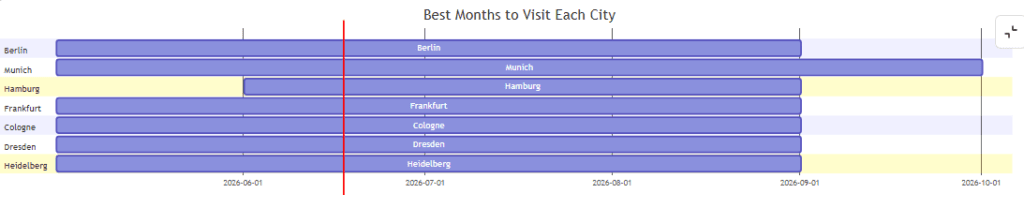
(Summer months May–Sept are generally best for all cities. Munich’s Alps also draw visitors in winter.)
Conclusion and Resources
Each of these destinations offers newcomers a different flavor of Germany – from cosmopolitan cities to historic small towns. We’ve provided costs, neighborhoods and practical tips to help you choose and settle in. For official travel info, see each city’s tourism website (e.g. Visit Berlin{target=”_blank”}, Cologne Tourism{target=”_blank”}), and for living costs consult Numbeo or Expatica city guides.
Ready to explore Germany’s beautiful cities? Check out our detailed Germany relocation guides and start planning your move today!
Sources: Official tourism sites and expat resources (VisitBerlin, Cologne Tourism, etc.) and cost data from Numbeo. Expatica and HousingAnywhere for neighborhood info. These support our cost ranges and city descriptions