Understanding Puma Aktie: Company Overview {#understanding-puma-aktie}
Puma SE (ticker: PUM on the Frankfurt Stock Exchange) represents one of the world’s most recognized sportswear brands. Founded in 1948 by Rudolf Dassler in Herzogenaurach, Germany, Puma has evolved into the third-largest sportswear manufacturer globally, trailing only Nike and Adidas.
Key Company Highlights
Business Segments:
- Footwear (53% of revenue): Performance and lifestyle shoes
- Apparel (32% of revenue): Athletic and casual wear
- Accessories (14% of revenue): Bags, socks, and licensed products
Geographic Reach:
- Europe, Middle East & Africa: 39% of sales
- Americas: 40% of sales
- Asia-Pacific: 21% of sales
The company Puma Aktie operates through wholesale partnerships, approximately 1,000 owned retail stores, and robust e-commerce channels across 120 countries. Understanding these fundamentals is crucial for anyone considering investing in Puma aktie in 2025-2026.
Related Reading: Financial Planning Strategies for Modern Investors | Understanding Stock Market Basics
Current Puma Aktie Stock Performance Analysis {#current-performance}
Recent Stock Movement and Market Challenges
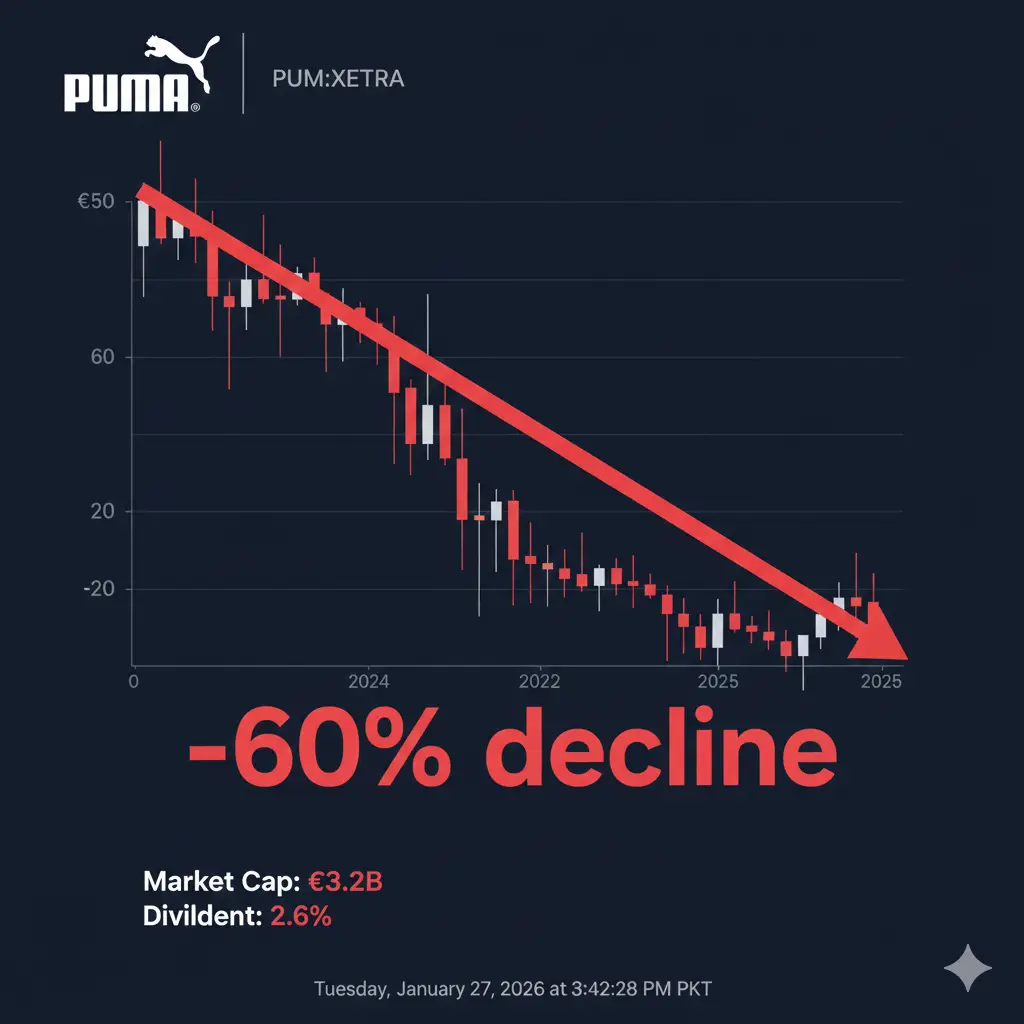
As of January 2026, Puma aktie has experienced significant volatility that demands investor attention. The stock has faced considerable pressure, with shares trading substantially lower than previous highs.
Key Performance Metrics:
According to Bloomberg and Google Finance, Puma’s recent performance shows:
- 2024 Revenue: €8.82 billion (4% growth year-over-year)
- Market Capitalization: Approximately €3.2 billion
- Recent Price Range: €17-€48 over past 12 months
- Dividend Yield: 2.64% – 2.96%
The dramatic stock decline from approximately €50 per share in early 2024 to around €20-22 per share represents a concerning trend for existing shareholders. However, value investors might see this as a potential opportunity.
What Happened to Puma Stock?
The significant decline came primarily from the company’s conservative guidance for 2025, which caught markets off-guard. Despite achieving record sales of €8.82 billion in 2024, profitability concerns dominated investor sentiment.
For those tracking Puma aktie performance, understanding these market dynamics is essential for making informed investment decisions.
Investment Resources: Portfolio Diversification Strategies | Risk Management in Stock Trading
Why Is Puma Aktie Down? Key Factors Explained {#why-puma-down}
Primary Challenges Facing Puma Stock
If you’re wondering why Puma stock is falling, several interconnected factors explain the decline:
1. Weak US Market Performance
The North American market, representing approximately one-third of Puma’s business, has shown significant weakness. CEO Arne Freundt specifically cited “the really soft market environment we have seen in the U.S.” as a primary concern.
Consumer sentiment in the United States has deteriorated, affecting sales projections and overall confidence in the company’s near-term performance.
2. Profitability Concerns Despite Revenue Growth
While Puma achieved 4% revenue growth in 2024, the company struggled to convert this growth into improved profitability. As noted by WWD, earnings decreased by 7.64% despite revenue increases.
This disconnect between top-line growth and bottom-line results concerned investors, leading to significant share price depreciation.
3. Conservative 2025 Guidance
Puma’s forecast for 2025 fell well below market expectations. The company predicted first-quarter sales would decline in low-single digits compared to 2024, a stark contrast to growth expectations.
4. Restructuring Costs
The company announced a cost-savings program involving:
- Reduction of approximately 900 jobs (later increased from initial 500)
- Closure of inefficient retail locations
- One-time restructuring costs of €75 million
These measures, while potentially beneficial long-term, created short-term uncertainty affecting Puma aktie price.
5. Increased Competition
According to Morningstar, Puma faces intensifying competition from:
- Market leaders Nike and Adidas
- Fast-growing brands like Lululemon, Deckers, Anta, and Li Ning
- Chinese competitors gaining market share globally
Takeover Speculation Impact
Interestingly, recent reports from Reuters and other financial news sources suggest that Chinese sportswear companies, including Anta Sports and Li Ning, have explored potential takeover bids for Puma. These rumors temporarily boosted the stock price by 10-13% during late 2025.
The Pinault family, which owns approximately 29% of Puma through their Kering investment group, has reportedly received offers for their stake. While takeover speculation can create short-term volatility, it also suggests that sophisticated investors see underlying value in the brand.
Market Analysis: Understanding Market Volatility | Economic Trends Impact on Investments
Puma Dividend Yield and Shareholder Returns {#dividend-analysis}
Understanding Puma’s Dividend Policy
For income-focused investors researching Puma aktie dividend yield, understanding the company’s distribution policy is crucial.
Current Dividend Metrics:
According to Investing.com and Puma’s Annual Report:
- Current Dividend Yield: 2.64% – 2.96%
- Annual Dividend: €0.61 per share (as of latest payment)
- Payout Ratio: Approximately 46-47%
- Payment Frequency: Annual
- Historical Policy: 25-35% of consolidated net income
Dividend Growth Analysis
Over the past five years, Puma has maintained an average dividend growth rate of 17.77%, though recent years have shown volatility. The three-year average growth rate has declined significantly due to profitability challenges.
Recent Dividend History:
- 2023: €0.82 per share (payout ratio: 40.3%)
- 2024: €0.82 per share (payout ratio: 34.7%)
- 2025: €0.61 per share (reflecting reduced earnings)
Is Puma’s Dividend Sustainable?
The current payout ratio of approximately 47% suggests moderate sustainability, though investors should monitor:
- Earnings stability: Recent losses in Q3 2025 raise concerns
- Free cash flow: Company emphasizes strong cash flow despite profitability issues
- Strategic priorities: Restructuring may temporarily affect dividend capacity
For conservative dividend investors, Puma aktie dividend yield offers moderate income, though growth prospects appear limited near-term.
Dividend Strategies: Building Passive Income Portfolios | Dividend Investment Guide
Investment Analysis: Is Puma Aktie Worth Buying? {#investment-analysis}
Comprehensive Investment Perspective
The question “is Puma aktie a good investment 2025” requires nuanced analysis considering multiple factors:
Bullish Arguments (Reasons to Buy)
1. Significant Valuation Discount
According to Morningstar’s analysis, Puma currently trades at substantially lower valuations compared to:
- Nike: Premium valuation despite recent China struggles
- Adidas: Trading with narrow-moat advantage
- Historical Puma multiples: Current price reflects significant pessimism
The stock’s decline from €50 to €20-22 suggests the market may have over-corrected, potentially creating a value opportunity.
2. Strong Brand Heritage and Recognition
Puma maintains significant brand equity as the third-largest sportswear company globally. The brand’s 75+ year history and distinctive positioning offer competitive advantages despite current challenges.
3. Strategic Refocusing
New leadership under CEO Arthur Hoeld focuses on simplifying operations and concentrating on core strengths:
- International football (soccer)
- Running and training categories
- Enhanced direct-to-consumer capabilities
These strategic initiatives could drive improved profitability once implemented.
4. Takeover Premium Potential
Ongoing interest from Chinese sportswear giants suggests strategic buyers see value. A successful takeover could provide shareholders with immediate gains above current market prices.
5. Cyclical Recovery Opportunity
The sportswear industry experiences cyclical patterns. Current weakness in consumer spending, particularly in the US, may reverse as economic conditions improve, benefiting Puma disproportionately given current pessimistic valuations.
Bearish Arguments (Reasons to Avoid)
1. Structural Competitive Disadvantages
Morningstar analysts note Puma lacks the “economic moat” (sustainable competitive advantage) of Nike and Adidas. Without defensible advantages, maintaining market share and pricing power remains challenging.
2. Ongoing Profitability Issues
The company’s inability to translate revenue growth into earnings growth raises fundamental concerns about business model efficiency and operational effectiveness.
3. Uncertain Market Environment
Weakness in key markets, especially North America, shows no clear signs of reversal. Consumer discretionary spending faces macroeconomic headwinds including:
- Potential recession risks
- Elevated inflation
- Changing consumer preferences
4. Execution Risk on Turnaround
While restructuring efforts aim to improve profitability, execution risks remain significant. Historical corporate turnarounds frequently disappoint initial expectations.
5. Dividend Cut Risk
Given earnings pressures, the company may reduce dividend payments to preserve cash for restructuring and operational needs.
Investment Verdict
For Aggressive Value Investors: Puma aktie presents a calculated risk-reward opportunity. The significant valuation discount, combined with turnaround potential and takeover speculation, could generate substantial returns for patient investors willing to accept volatility.
For Conservative Investors: Current uncertainty and profitability challenges suggest waiting for clearer signs of operational improvement before investing. The dividend, while decent, faces sustainability questions.
For Growth Investors: Other opportunities likely offer better risk-adjusted return prospects. Puma’s growth trajectory remains uncertain despite revenue gains.
Investment Education: Value Investing Principles Explained | Risk Assessment Strategies
Puma Stock Forecast 2025-2026 {#future-forecast}
Near-Term Outlook (2025)
Based on company guidance and analyst perspectives, Puma aktie prognose for 2025 suggests:
Revenue Expectations:
- Modest growth or flat performance
- First-half weakness, potential second-half recovery
- Continued challenges in North American market
Profitability Outlook:
- Restructuring costs impacting near-term results
- Gradual margin improvement expected second half
- Full benefits of cost-savings program delayed to 2026
Stock Price Projection:
- Trading range likely €18-€30
- High volatility expected
- Takeover developments could significantly impact valuation
Medium-Term Perspective (2026)
CEO statements suggest 2025 represents a “reset year” with 2026 positioning as a “transition year.” This timeline indicates:
- 2025: Focus on operational improvements, cost reduction
- 2026: Initial benefits from strategic refocusing
- 2027 and beyond: Potential return to sustainable growth
Key Factors Influencing Future Performance
- US Economic Recovery: Critical for sales momentum
- Restructuring Success: Operational efficiency gains
- Competitive Positioning: Market share defense in key categories
- M&A Activity: Takeover bid success probability
- Consumer Spending Trends: Discretionary spending recovery
Analyst Perspectives
According to sources like StockAnalysis.com, analyst opinions remain mixed:
- Optimistic View: Significant upside if turnaround succeeds
- Cautious View: Further downside risk until clarity emerges
- Neutral View: Fair value around current levels, limited conviction either direction
For investors seeking Puma stock forecast 2026, patience and risk management remain essential given elevated uncertainty.
Market Forecasting: Economic Indicators to Watch | Industry Trend Analysis
How to Invest in Puma Aktie {#how-to-invest}
Step-by-Step Investment Guide
For those ready to proceed with investing in Puma stock, here’s a comprehensive guide:
Step 1: Choose Your Investment Platform
German Investors:
- Trade Republic: Low-cost, user-friendly German broker
- Scalable Capital: Competitive fees, extensive research tools
- Comdirect: Comprehensive platform with educational resources
- ING DiBa: Established bank with integrated trading
International Investors:
- Interactive Brokers: Global access, competitive pricing
- Trading 212: Commission-free trading
- eToro: Social trading features
- DEGIRO: Low-fee European broker
Step 2: Research Investment Amount
Consider:
- Risk tolerance: Only invest what you can afford to lose
- Portfolio allocation: Typically 2-5% maximum for individual stocks
- Diversification: Balance with other holdings
Step 3: Understand Different Ways to Invest
Direct Stock Purchase:
- Buy PUM shares on Frankfurt Stock Exchange (XETRA)
- Own actual shares, receive dividends
- Long-term capital gains treatment
American Depositary Receipts (ADRs):
- Trade under PUMSY (OTC market) in USD
- Convenient for US investors
- May have slightly different pricing
ETF Exposure:
- Consumer discretionary ETFs
- German stock market ETFs (DAX)
- Sportswear industry ETFs
- Lower individual stock risk
CFDs/Options (Advanced):
- Higher risk, leverage available
- Suitable only for experienced traders
- Significant loss potential
Step 4: Place Your Order
Order Types:
- Market Order: Immediate execution at current price
- Limit Order: Specify maximum purchase price
- Stop-Loss: Automatic sell if price falls to specified level
Best Practices:
- Use limit orders for better price control
- Set stop-losses to manage downside risk
- Consider cost averaging during volatility
Step 5: Monitor and Manage Your Investment
Regular Review Schedule:
- Quarterly earnings reports
- Annual shareholder meetings
- Industry news and competitor developments
- Broader market conditions
When to Consider Selling:
- Fundamental deterioration beyond expectations
- Successful turnaround completion (take profits)
- Portfolio rebalancing needs
- Better opportunities emerge
Tax Considerations
Germany:
- Capital gains tax (Abgeltungsteuer): 25% plus solidarity surcharge
- €1,000 annual exemption (€2,000 for couples)
- Dividends taxed similarly
International:
- Check local tax treaties
- Withholding tax considerations
- Consult tax professional for specific guidance
Investment Tools: Portfolio Management Strategies | Tax-Efficient Investing Guide
Puma vs Competitors: Comparative Analysis {#competitive-analysis}
Understanding Puma Aktie vs Adidas Aktie and Nike
Market Position Comparison
Nike (Global Leader):
- Market Cap: ~$110 billion (significantly larger)
- Revenue: ~$51 billion
- Competitive Advantages: Wide economic moat, brand power, innovation leadership
- Recent Challenges: China market weakness, inventory issues
- Stock Performance: Volatile but historically strong returns
Adidas (Primary Competitor):
- Market Cap: ~€40 billion
- Revenue: ~€22 billion
- Competitive Advantages: Narrow moat, strong brand, European leadership
- Recent Challenges: Yeezy partnership termination, restructuring
- Stock Performance: Recovery mode after significant 2022-2023 challenges
Puma (Subject Company):
- Market Cap: ~€3.2 billion (much smaller)
- Revenue: ~€8.8 billion
- Competitive Position: No defensible moat, third-tier player
- Current Challenges: Profitability, US market, competition
- Stock Performance: Significant recent decline
Valuation Metrics Comparison
According to Morningstar analysis:
| Metric | Nike | Adidas | Puma |
|---|---|---|---|
| P/E Ratio | 22-25x | 18-22x | Negative (recent losses) |
| Dividend Yield | ~2.0% | ~1.0% | ~2.6% |
| Revenue Growth | 0-5% | 5-10% | 2-4% |
| Margin Profile | High (11-12%) | Mid (9-10%) | Low (3-4%) |
Puma trades at a significant discount, but this reflects genuine competitive and operational challenges rather than simple market inefficiency.
Competitive Advantages Analysis
Where Puma Leads:
- Lifestyle/casual sportswear positioning
- Select international football partnerships
- Certain regional markets (particularly Latin America)
- Price-value proposition
Where Puma Trails:
- Innovation and technology
- Marketing budget and reach
- Retail presence and brand equity
- Profitability and scale advantages
Alternative Investment Considerations
For investors considering Puma aktie, alternatives include:
Higher Quality Options:
- Adidas: Better competitive position, turnaround progress
- Nike: Premium quality, long-term growth leader
- Lululemon: High-growth activewear specialist
Similar Risk-Reward Profile:
- Under Armour: North American turnaround story
- Asics: Japanese sportswear value play
- Li Ning/Anta: Chinese market growth opportunities
The choice depends on your specific investment thesis, risk tolerance, and portfolio objectives.
Comparative Analysis: Industry Leader Comparisons | Competitive Analysis Framework
Expert Investment Strategies for Puma Stock {#investment-strategies}
Strategic Approaches for Different Investor Types
Strategy 1: Value Investment Approach (Patient Capital)
Thesis: Current weakness presents opportunity for patient investors
Implementation:
- Entry: Scale into position over 3-6 months
- Size: Small position (2-3% of portfolio maximum)
- Holding Period: 2-3 years minimum
- Exit Strategy: Turnaround validation or takeover
Risk Management:
- Use limit orders 10-15% below current market
- Set stop-loss at 25-30% below entry
- Monitor quarterly earnings religiously
- Be prepared for continued volatility
Best For: Experienced investors comfortable with turnaround risk
Strategy 2: Dividend Income Focus (Cash Flow)
Thesis: Maintain exposure for dividend while market recovers
Implementation:
- Entry: Small initial position
- Dividend Reinvestment: Automatically compound through DRIP
- Yield Target: Maintain 2.5%+ yield on cost
- Rebalancing: Reduce position if dividend cut occurs
Risk Management:
- Diversify dividend portfolio (10+ positions)
- Monitor payout ratio quarterly
- Set dividend cut as automatic review trigger
- Consider hedging strategies if available
Best For: Income-focused investors with dividend sustainability confidence
Strategy 3: Speculative Takeover Play (Event-Driven)
Thesis: M&A activity drives near-term returns
Implementation:
- Entry: Small speculative position (1-2% max)
- Monitoring: Track takeover news daily
- Timeline: 6-12 month expected resolution
- Exit: Significant premium to current price or news resolution
Risk Management:
- Acknowledge complete loss possibility
- Set strict position size limits
- Use options strategies if sophisticated (e.g., call options)
- Have pre-defined exit if deal falls apart
Best For: Sophisticated investors comfortable with event-driven investing
Strategy 4: Wait-and-See Approach (Patience)
Thesis: More information needed before commitment
Implementation:
- Watchlist: Monitor quarterly earnings and news
- Entry Triggers: Clear turnaround evidence, guidance raise, or further price weakness
- Preparation: Maintain cash reserves for opportunistic entry
- Research: Continue educating on industry and company
Risk Management:
- Avoid FOMO (fear of missing out) decisions
- Require multiple positive data points
- Be willing to miss initial recovery
- Focus on risk-adjusted returns
Best For: Conservative investors prioritizing capital preservation
Position Sizing Recommendations
Based on risk profile:
Aggressive Portfolio: Up to 5% allocation Moderate Portfolio: 2-3% allocation Conservative Portfolio: 0-1% allocation or avoid entirely
Remember: Never invest money you cannot afford to lose, especially in turnaround situations with elevated uncertainty.
Strategy Development: Creating Your Investment Plan | Risk Management Best Practices
Frequently Asked Questions {#faq}
Is Puma Aktie a Good Investment Right Now?
Puma aktie presents a high-risk, potentially high-reward opportunity suitable primarily for experienced investors with appropriate risk tolerance. The stock trades at depressed valuations reflecting genuine operational challenges, but turnaround potential and takeover speculation offer upside possibility. Conservative investors should likely wait for clearer signs of improvement before committing capital.
Why Is Puma Stock Falling So Much?
The significant decline stems from multiple factors: conservative 2025 guidance disappointing markets, ongoing profitability challenges despite revenue growth, weakness in the critical US market, and intensifying competitive pressures. Additionally, restructuring costs and uncertainty about turnaround success have created negative sentiment.
What Is Puma’s Dividend Yield?
Puma currently offers a dividend yield of approximately 2.6-2.9%, with annual dividend payments of €0.61 per share. The company maintains a payout ratio around 46-47% of earnings, though dividend sustainability faces questions given recent profitability challenges. Historically, Puma targets 25-35% payout ratios.
Should I Buy Puma Stock After the Recent Decline?
This depends entirely on your investment objectives, risk tolerance, and portfolio composition. The stock’s decline creates potential value opportunity, but significant risks remain. Value investors with patience might find current levels attractive, while conservative investors should probably wait. Never invest based solely on price decline without understanding underlying fundamentals.
How Does Puma Compare to Nike and Adidas Stock?
Puma is significantly smaller and less profitable than both Nike and Adidas, lacking the sustainable competitive advantages (economic moats) those companies possess. While Puma trades at substantial discounts, this reflects genuine competitive disadvantages. However, Puma’s smaller size could enable faster growth if turnaround succeeds.
What Is the Forecast for Puma Aktie in 2026?
Company leadership characterizes 2025 as a “reset year” and 2026 as a “transition year,” suggesting meaningful improvement will take time. Analysts expect continued volatility with potential trading range of €18-€30. Successful restructuring implementation and economic recovery could drive outperformance, while execution failures could prompt further declines.
How Do I Buy Puma Stock as a US Investor?
US investors can purchase Puma through American Depositary Receipts (ADRs) trading under ticker PUMSY on OTC markets. Alternatively, US investors with international brokerage access can trade PUM directly on Frankfurt Stock Exchange (XETRA). Consider transaction costs, currency exchange, and tax implications when investing internationally.
Is Puma Being Acquired?
Reports suggest Chinese sportswear companies Anta Sports and Li Ning have explored potential takeover bids, with specific interest in the Pinault family’s 29% stake. However, no definitive agreement exists as of January 2026. Takeover speculation creates volatility but may not materialize into actual transaction.
What Are the Main Risks of Investing in Puma Aktie?
Key risks include: continued US market weakness, failure of restructuring efforts, intensifying competition from larger rivals, potential dividend cuts, execution risk under new leadership, macroeconomic headwinds affecting consumer spending, and currency fluctuations for international investors. Position sizing and risk management remain critical.
Where Can I Find Reliable Puma Stock Information?
Authoritative sources include:
- Company Investor Relations: Puma SE Official IR
- Financial News: Bloomberg, Reuters
- Stock Analysis: Morningstar, Yahoo Finance
- German Sources: Finanzen.net, Börse Frankfurt
Always verify information from multiple reputable sources before making investment decisions.
Conclusion: Making Your Puma Aktie Investment Decision
Investing in Puma aktie in 2025-2026 requires careful consideration of both risks and opportunities. The company faces genuine operational challenges reflected in its stock price decline, yet trades at potentially compelling valuations for investors with appropriate risk tolerance and patience.
Key Takeaways:
For Potential Investors:
- ✅ Significant valuation discount exists versus historical levels
- ✅ Turnaround potential under new leadership
- ✅ Takeover speculation adds upside optionality
- ✅ Decent dividend yield (though sustainability questioned)
- ❌ Profitability challenges persist despite revenue growth
- ❌ Competitive position weaker than Nike/Adidas
- ❌ US market weakness shows no clear reversal signs
- ❌ Execution risk on restructuring remains elevated
Investment Approach Recommendations:
- Size positions appropriately (typically 2-3% maximum for moderate portfolios)
- Use strict risk management with stop-losses and position limits
- Maintain patience through volatility
- Monitor quarterly results religiously
- Diversify rather than concentrating bets
Final Verdict
Puma aktie represents a classic turnaround situation: high risk, high potential reward. While the stock’s decline creates opportunity, investors must honestly assess their risk tolerance, investment timeline, and conviction level before committing capital. Conservative investors should likely avoid or wait for clearer improvement signals, while experienced value investors might find current levels intriguing for small, well-managed positions.
Remember: This analysis provides educational information, not personalized financial advice. Always conduct your own due diligence, consider your specific circumstances, and consult qualified financial advisors before making investment decisions.
Additional Resources
Further Reading on LumeChronos
- Understanding Financial Markets
- Investment Strategy Development
- Risk Management Best Practices
- Building Diversified Portfolios
External Authoritative Sources
- Puma SE Official Investor Relations
- Bloomberg Market Data
- Morningstar Stock Analysis
- Frankfurt Stock Exchange
- Federal Financial Supervisory Authority (BaFin)
About the Author: This comprehensive analysis was created by the LumeChronos financial research team, dedicated to providing accessible, accurate, and actionable investment information. Our mission is simplifying complex financial topics through thorough research and clear communication.
Disclaimer: This article is for informational and educational purposes only. It does not constitute financial, investment, or legal advice. Investing in stocks carries significant risk, including potential loss of principal. Past performance does not guarantee future results. Always conduct your own research and consult with qualified financial professionals before making investment decisions.