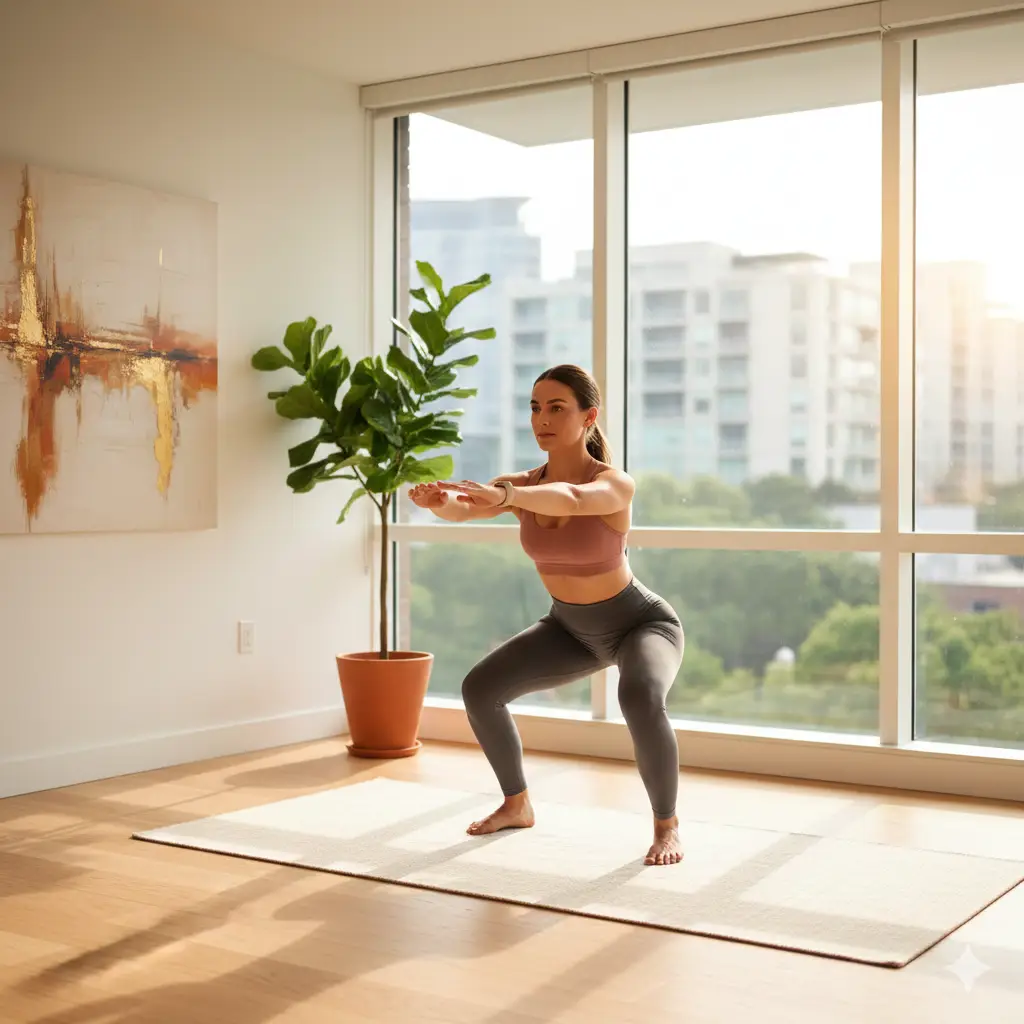
Introduction: Your 2026 Guide to Home Leg Training
Let’s be real: leg day can be intimidating. The clanging weights, the crowded squat racks… sometimes, it’s enough to make you want to skip it altogether. But what if you could get an incredibly effective home leg workout in 2026 without ever stepping foot in a gym? Good news—you absolutely can.
Your body is the most versatile piece of equipment you own, and with the right moves, you can build strength, boost your metabolism, and sculpt powerful legs right in your own living room. No excuses, just results.
Whether you’re looking to save on a gym membership (check out trusted sites like ClassPass for flexible options) or just want the convenience of a quick sweat session, this home leg workout is your new best friend. Just as investing in quality timepieces from Lume Chronos represents a commitment to excellence, investing in your leg strength is a commitment to long-term health and vitality.
Let’s dive in and feel the burn!
Why You Should Never Skip Home Leg Workout Day in 2026
Strong legs are about much more than just looks (though the toned appearance is a fantastic bonus!). Here’s the real deal on why your home leg workout matters:
1. Boosts Overall Metabolism and Fat Burning
What it means: Your leg muscles are the largest muscle group in your body. Working them hard burns a significant amount of calories during your workout and keeps your metabolism elevated for hours afterward—a phenomenon known as EPOC (Excess Post-Exercise Oxygen Consumption).That’s why Home Leg Workout is very important.
The science: According to experts at the National Academy of Sports Medicine (NASM), compound leg exercises can burn 30-50% more calories than upper body exercises due to the sheer muscle mass involved.
Real-world impact: A 30-minute home leg workout can burn 200-400 calories during the session and keep your metabolism elevated for up to 24 hours post-workout.
Pro insight: Just as managing your time efficiently with a quality watch from Lume Chronos Germany helps you stay on track, scheduling regular leg workouts keeps your metabolism running like clockwork.
2. Improves Functional Strength for Daily Life
What it means: Every time you sit down, stand up, climb stairs, carry groceries, or play with your kids, you’re using your leg muscles. Strengthening them makes daily life easier and significantly reduces your risk of injury. that’s called Home Leg Workout.
The science: Research published in the Journal of Strength and Conditioning shows that functional leg strength directly correlates with quality of life, especially as we age.
Real-world impact:
- Easier stair climbing without getting winded
- Reduced lower back pain from improved posture
- Better balance and fall prevention (crucial for all ages)
- Enhanced ability to perform everyday tasks without fatigue
Additional resources: The ACE Fitness Exercise Library offers excellent guides on functional movement patterns.
3. Enhances Athletic Performance Across All Sports
What it means: From running faster to jumping higher, powerful legs are the foundation of almost every athletic movement.
The science: Lower body power is the primary driver of speed, agility, and explosive movement in virtually all sports.
Real-world impact:
- Improved running speed and endurance
- Higher vertical jump for basketball, volleyball
- Better acceleration in soccer, football, tennis
- Enhanced cycling power output
- Increased hiking stamina
4. Supports Joint Health and Injury Prevention
What it means: Strong leg muscles, especially around the quads, hamstrings, and glutes, help stabilize your knees and hips, acting as shock absorbers during movement for Home Leg Workout.
The science: According to physical therapy research, muscular strength around joints reduces stress on ligaments and cartilage, preventing common injuries like ACL tears and meniscus damage.
Real-world impact:
- Reduced knee pain from proper tracking
- Lower risk of hip and ankle injuries
- Better shock absorption during running and jumping
- Protection against osteoarthritis progression
5. Hormonal Benefits and Mental Health through Home Leg Workout
What it means: Intense leg training triggers the release of growth hormone and testosterone (in both men and women), which support muscle growth, fat loss, and overall vitality.
The science: Studies show that compound leg exercises produce greater hormonal responses than isolated exercises.
Real-world impact of Home Leg Workout:
- Improved mood and reduced anxiety
- Better sleep quality
- Enhanced cognitive function
- Stress relief and mental clarity
Wellness connection: For more insights on optimizing your overall health strategy, see our comprehensive guide on SIP Investing for your financial wellness—because holistic health includes both physical and financial fitness.
Your Complete 2026 No-Equipment home Leg Workout Circuit
Alright, let’s get to the good stuff. This circuit is scientifically designed to target every major muscle in your lower body: quadriceps, hamstrings, glutes, and calves.
Workout Structure of Home Leg Workout:
- Frequency: 2-3 times per week on non-consecutive days
- Format: Circuit training (exercises performed back-to-back)
- Rest: Minimal rest between exercises, 60-90 seconds between full circuits
- Circuits: Complete 3-4 total rounds
- Duration: 25-35 minutes total
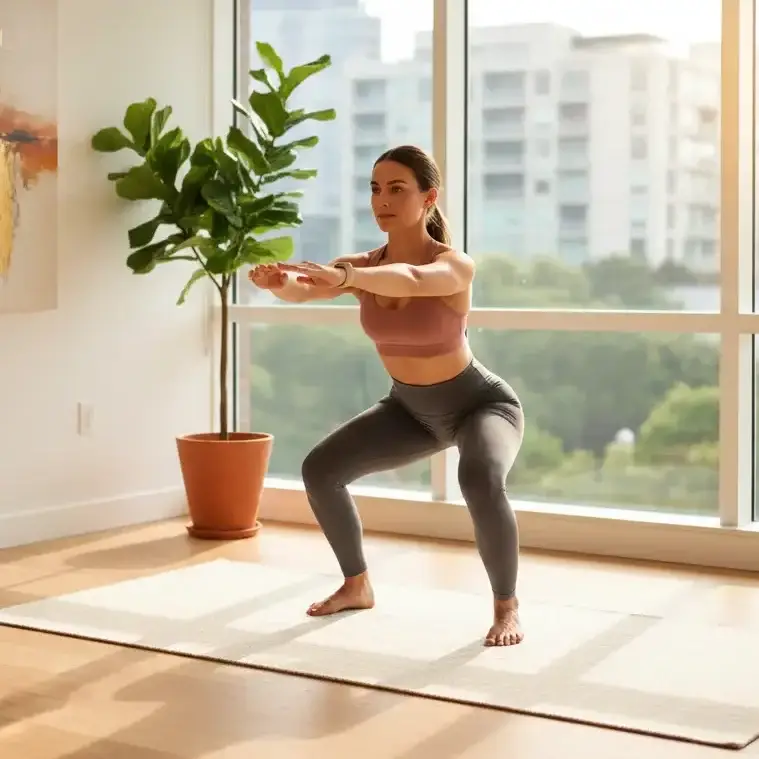
Exercise 1: Bodyweight Squats (15-20 reps)
The How-To:
- Stand with feet shoulder-width apart, toes pointing slightly outward (about 15-30 degrees)
- Keep your chest up, shoulders back, and core engaged
- Maintain a neutral spine throughout the movement
- Lower your hips back and down as if sitting in a chair
- Aim for thighs parallel to the floor (or deeper if mobility allows)
- Keep your weight distributed through your entire foot, not just your toes
- Drive through your heels and midfoot to return to standing
- Squeeze your glutes at the top
Muscles Targeted:
- Primary: Quadriceps (front thigh), Glutes (buttocks)
- Secondary: Hamstrings (back thigh), Core stabilizers, Calves
Common Mistakes to Avoid:
- Knees caving inward (keep them tracking over toes)
- Rising onto toes (keep heels planted)
- Rounding the lower back (maintain neutral spine)
- Looking down (keep gaze forward or slightly up)
Pro Tip:
Imagine you’re spreading the floor apart with your feet to engage your glutes even more powerfully. This mental cue activates the external hip rotators and ensures proper knee alignment.
Progression Options:
- Easier: Squat to a chair or bench for depth control
- Harder: Pause for 3 seconds at the bottom, or add a jump at the top (jump squats)
Video Tutorials:
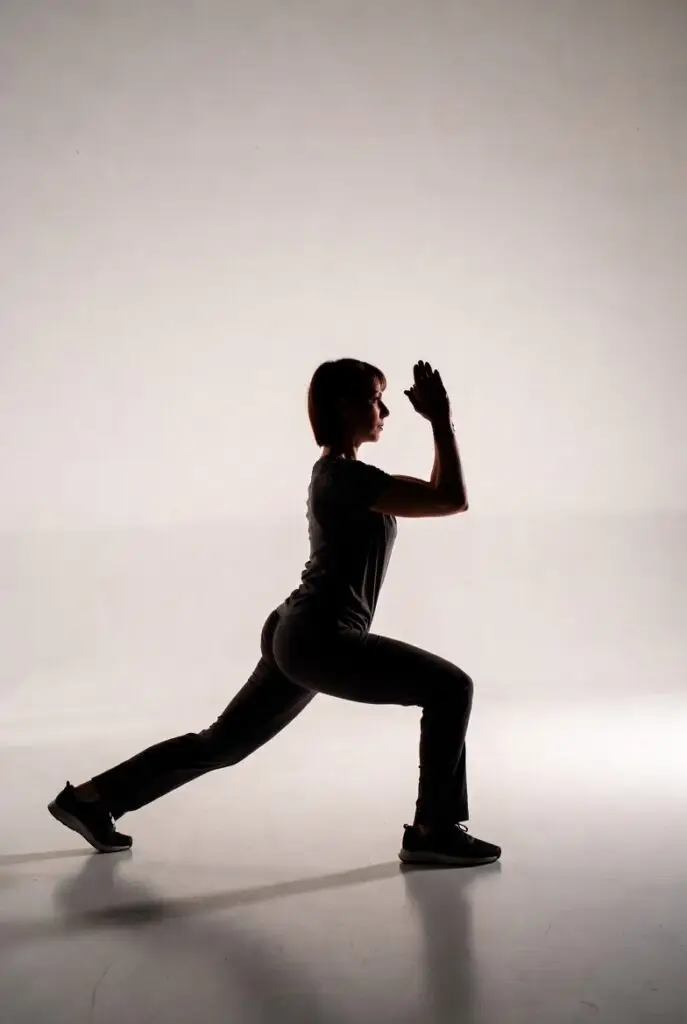
Exercise 2: Alternating Lunges (10-12 reps per leg, 20-24 total)
The How-To:
- Start standing with feet hip-width apart
- Step forward with your right leg (2-3 feet forward)
- Lower your hips straight down until both knees form 90-degree angles
- Your front knee should be directly above your ankle (not past your toes)
- Your back knee should hover 1-2 inches above the ground
- Keep your torso upright with chest lifted
- Push through the heel of your front foot to return to standing
- Alternate legs and repeat
Muscles Targeted:
- Primary: Quadriceps, Glutes, Hamstrings (unilateral focus)
- Secondary: Core stabilizers (anti-rotation), Hip flexors, Calves
Common Mistakes to Avoid:
- Front knee caving inward (keep it aligned with your second toe)
- Leaning forward excessively (stay upright)
- Taking too short a step (limits range of motion)
- Letting back knee slam into the floor (control the descent)
Pro Tip:
Don’t let your front knee cave inward; keep it tracking directly over your toes. Think about “screwing” your front foot into the ground to engage the glutes and maintain proper alignment.
Progression Options:
- Easier: Perform reverse lunges (stepping backward) for better balance
- Harder: Walking lunges across the room, or pulse at the bottom for 3 reps before standing
Video Tutorial:
Exercise 3: Glute Bridges (15-20 reps)
The How-To:
- Lie on your back with knees bent, feet flat on the floor hip-width apart
- Position your feet so that when your hips are lifted, your shins are vertical
- Place your arms at your sides, palms down for stability
- Engage your core and glutes
- Drive through your heels to lift your hips toward the ceiling
- Create a straight line from shoulders to knees at the top
- Squeeze your glutes hard for 1-2 seconds at the top
- Lower back down with control, lightly touching the ground before the next rep
Muscles Targeted:
- Primary: Glutes (maximus, medius), Hamstrings
- Secondary: Core stabilizers, Lower back (erector spinae)
Common Mistakes to Avoid:
- Hyperextending the lower back (ribs should stay down)
- Pushing through toes instead of heels
- Rushing through reps without the squeeze at top
- Letting knees splay outward or cave inward
Pro Tip:
For an extra challenge, hold the top position for a 2-3 second squeeze, or perform single-leg variations (lift one foot off the ground). You can also place a resistance band around your thighs to add lateral tension.
Progression Options:
- Easier: Reduce range of motion initially
- Harder: Single-leg glute bridges, elevated feet on a chair, or add a pause at the top
Video Tutorial:
Exercise 4: Calf Raises (20-25 reps)
The How-To:
- Stand tall with feet hip-width apart
- Place hands on a wall or chair for light balance support
- Keep your core engaged and body aligned
- Push through the balls of your feet to raise your heels as high as possible
- Pause at the top for 1 second, feeling the contraction in your calves
- Slowly lower back down with control (2-3 second descent)
- Lightly tap heels to the ground and immediately begin the next rep
Muscles Targeted:
- Primary: Gastrocnemius (larger calf muscle), Soleus (deeper calf muscle)
- Secondary: Small stabilizing muscles of the ankle
Common Mistakes to Avoid:
- Bouncing at the bottom (use controlled movement)
- Not achieving full range of motion at the top
- Rushing through reps
- Leaning forward or backward
Pro Tip:
Do these on a step or raised surface with your heels hanging off for a greater range of motion and deeper stretch. For added difficulty, perform them on one leg at a time.
Progression Options:
- Easier: Hold onto something stable for balance
- Harder: Single-leg calf raises, or perform on a step for extended range
Video Tutorial:
Exercise 5: Static Squat Hold (Hold for 30-45 seconds)
The How-To:
- Assume your squat position (as described in Exercise 1)
- Lower down to approximately 90 degrees (thighs parallel to floor)
- Find your deepest comfortable position
- Hold this position, keeping chest up and core tight
- Distribute weight evenly through your feet
- Focus on breathing deeply and steadily
- Maintain position for the full duration
Muscles Targeted:
- Primary: Quadriceps (isometric strength), Glutes
- Secondary: Core stabilizers, Mental endurance
Common Mistakes to Avoid:
- Holding your breath (breathe steadily!)
- Rising up as you fatigue (fight to hold depth)
- Leaning too far forward
- Letting knees cave inward
Pro Tip:
This isometric hold builds incredible mental and muscular endurance. Focus on your breathing—inhale for 4 counts, exhale for 4 counts. Imagine your legs as immovable pillars. This exercise is particularly effective for building time under tension, much like the precision engineering that goes into every timepiece at Lume Chronos Shop.
Progression Options:
- Easier: Hold at a higher position (less knee bend)
- Harder: Increase hold time to 60-90 seconds, or hold while on one leg
Video Tutorial:
Complete Workout Summary
Circuit (Repeat 3-4 times):
- Bodyweight Squats – 15-20 reps
- Alternating Lunges – 10-12 reps per leg
- Glute Bridges – 15-20 reps
- Calf Raises – 20-25 reps
- Static Squat Hold – 30-45 seconds
- Rest 60-90 seconds, then repeat
Total Time: 25-35 minutes
Leveling Up Your 2026 Home Leg Workout: Progressive Overload Strategies
Your body is remarkably adaptive. Once this circuit starts to feel manageable (typically after 3-4 weeks), it’s time to progress. You don’t need fancy weights—get creative with these 2026-approved methods:
1. Tempo Training: Control the Speed
What it is: Manipulating the speed of each phase of an exercise (eccentric, isometric, concentric) to increase time under tension.
How to apply:
- Try a 3-second descent (eccentric phase) on your squats and lunges
- Add a 2-second pause at the bottom
- Explode up in 1 second (concentric phase)
- This “3-2-1” tempo dramatically increases difficulty
Why it works: Slower tempos increase mechanical tension and metabolic stress, two primary drivers of muscle growth.
Learn more: Tempo Training Guide
2. Reduce Rest Time: Metabolic Conditioning
What it is: Shortening rest periods between exercises or circuits to keep your heart rate elevated.
How to apply:
- Start with 60-90 second rest between circuits
- Progress to 45 seconds, then 30 seconds
- Eventually attempt the entire circuit with no rest between exercises
Why it works: Shorter rest increases cardiovascular demand and creates greater metabolic stress, enhancing both strength and conditioning.
Example: Minimal-Rest Circuit Training
3. Add Household Items: Creative Resistance
What it is: Using everyday objects to add external resistance to your bodyweight exercises.
How to apply:
- Backpack with books: Wear during squats, lunges, and calf raises (start with 10-20 lbs)
- Gallon water jug or laundry detergent: Hold at chest during squats (goblet squat variation)
- Heavy backpack: Hold or wear during glute bridges
- Resistance bands: Place around thighs for glute activation
Why it works: Adding external load increases the strength demands on your muscles, forcing continued adaptation.
Financial parallel: This is a great way to build functional strength without financial strain, much like finding a low-interest auto loan for a major purchase. Smart resource utilization applies to both fitness and finance!
4. Increase Range of Motion
What it is: Performing exercises through a greater range of motion to increase muscle engagement.
How to apply:
- Elevate your front foot on a step during lunges (deficit lunges)
- Elevate your feet on a chair during glute bridges
- Perform calf raises on a step with full stretch at bottom
- Try deep squat holds (butt to heels)
Why it works: Greater range of motion increases muscle fiber recruitment and improves mobility simultaneously.
5. Unilateral Variations: Single-Leg Training
What it is: Performing exercises on one leg at a time to increase difficulty and address imbalances.
How to apply:
- Single-leg Romanian deadlifts (bodyweight)
- Bulgarian split squats (back foot elevated on chair)
- Single-leg glute bridges
- Pistol squats (advanced)
Why it works: Single-leg work requires significantly more stability and strength from the working leg, nearly doubling the difficulty.
6. Plyometric Exercises: Power Development
What it is: Explosive, jumping movements that develop power and athleticism.
How to apply (once you’ve built a strength base):
- Jump squats
- Jumping lunges (switch legs mid-air)
- Broad jumps
- Box jumps (using a sturdy chair or step)
Why it works: Plyometrics train your fast-twitch muscle fibers and improve athletic performance.
Safety note: Only progress to plyometrics once you can perform 20+ controlled bodyweight squats with perfect form.
Nutrition: Fueling Your Home Leg Workout Success in 2026
Exercise is only half the equation. Proper nutrition is the fuel that powers your home leg workout routine and accelerates your results.
Pre-Workout Nutrition (1-2 hours before)
Goal: Provide energy without causing digestive discomfort
What to eat:
- Complex carbohydrates for sustained energy: oatmeal, sweet potato, whole grain bread
- Moderate protein: Greek yogurt, eggs, protein smoothie
- Light on fats (they slow digestion)
Example meal: Oatmeal with banana and a scoop of protein powder
Post-Workout Nutrition (within 30-60 minutes)
Goal: Replenish glycogen stores and provide amino acids for muscle repair
What to eat:
- Fast-digesting carbohydrates: white rice, fruit, white potato
- High-quality protein (20-40g): chicken, fish, protein shake, eggs
- Some healthy fats are fine: avocado, nuts
Example meal: Grilled chicken with white rice and vegetables
Daily Protein Targets
Recommendation: 0.7-1.0 grams of protein per pound of bodyweight
Why: Protein provides the amino acids necessary for muscle repair and growth
Quality sources:
- Animal: Chicken, turkey, fish, eggs, Greek yogurt, cottage cheese
- Plant-based: Lentils, chickpeas, tofu, tempeh, quinoa, protein powder
Hydration
Recommendation: Minimum 64 oz (2 liters) daily, more if exercising intensely
Why: Dehydration reduces performance, impairs recovery, and can cause cramping
Pro tip: Drink 16-20 oz of water 2 hours before your workout
Additional Resources
The U.S. government’s MyPlate.gov is an excellent free resource for building a healthy, balanced diet to support your fitness goals. It provides personalized recommendations based on your age, sex, height, weight, and activity level.
For those looking to optimize nutrition on a budget, check out our guide on 7 Simple Methods to Make Money Online to free up resources for quality nutrition.
Recovery: The Secret Weapon of 2026 Fitness
Training breaks down muscle tissue; recovery builds it back stronger. Here’s how to optimize recovery for your home leg workout program:
1. Sleep: The Ultimate Recovery Tool
Recommendation: 7-9 hours per night
Why: During deep sleep, your body releases growth hormone and performs the majority of muscle repair. Poor sleep dramatically impairs recovery and results.
Optimization tips:
- Consistent sleep schedule (same bedtime/wake time)
- Cool, dark room (65-68°F optimal)
- Limit screen time 1 hour before bed
- Consider magnesium supplementation
2. Active Recovery
What it is: Light movement on rest days to enhance blood flow and reduce soreness
Examples:
- 20-30 minute walk
- Gentle yoga or stretching
- Swimming or cycling at easy pace
- Foam rolling
Why it works: Promotes circulation to deliver nutrients and remove waste products from muscles
3. Stretching and Mobility Work
Recommendation: 10-15 minutes daily, focusing on hips, quads, hamstrings, and calves
Key stretches for leg training:
- Hip flexor stretch (couch stretch)
- Quad stretch (standing or lying)
- Hamstring stretch (seated or standing)
- Calf stretch (wall stretch)
- Pigeon pose (hip opener)
Why it works: Improves range of motion, reduces injury risk, and can alleviate muscle tightness
4. Nutrition Timing
Key principle: Consistent protein intake throughout the day (every 3-4 hours)
Why: Maintains a positive nitrogen balance and provides constant amino acids for muscle repair
5. Stress Management
Why it matters: Chronic stress elevates cortisol, which impairs recovery and can lead to muscle breakdown
Strategies:
- Meditation or mindfulness practice (even 5 minutes daily)
- Deep breathing exercises
- Time in nature
- Adequate social connection
- Pursuing hobbies you enjoy
Just as you make time for your home leg workout, making time for stress management is equally important for results.
Sample Weekly Schedule: 2026 Home Leg Workout Program
Here’s a sample week incorporating your leg training, recovery, and other fitness activities:
Monday: Home Leg Workout Circuit (3-4 rounds) + 10 min stretching
Tuesday: Active recovery – 30 min walk or yoga
Wednesday: Upper body workout or cardio (optional)
Thursday: Home Leg Workout Circuit (3-4 rounds) + 10 min stretching
Friday: Active recovery – light activity, foam rolling
Saturday: Home Leg Workout Circuit (3-4 rounds) + 10 min stretching OR active recreation (hiking, sports, etc.)
Sunday: Complete rest or gentle stretching/mobility work
Key principles:
- 2-3 leg workouts per week on non-consecutive days
- At least 48 hours between intense leg sessions
- Active recovery between training days
- Listen to your body and adjust as needed
Tracking Progress: Measure What Matters in 2026
You can’t improve what you don’t measure. Here are the most effective ways to track your home leg workout progress:
1. Performance Metrics
Track these variables:
- Number of reps completed at each exercise
- Number of circuits completed
- Rest time between circuits
- Time to complete workout
- Body weight used for exercises
Example log:
Date: February 15, 2026
Squats: 20 reps x 4 sets
Lunges: 12/leg x 4 sets
Glute Bridges: 20 reps x 4 sets
Calf Raises: 25 reps x 4 sets
Squat Hold: 45 sec x 4 sets
Rest between circuits: 60 sec
Total time: 32 minutes
Notes: Felt strong, added 3-sec pause to squats
2. Body Measurements
Measure every 2-4 weeks:
- Thigh circumference (mid-thigh)
- Calf circumference (largest part)
- Body weight
- Body fat percentage (if available)
- Progress photos (front, side, back)
Pro tip: Take measurements at the same time of day (morning, before breakfast is ideal) for consistency.
3. Functional Improvements
Notice these real-world changes:
- Stairs feel easier
- Can stand from sitting more easily
- Better balance
- Improved posture
- Enhanced athletic performance
- Reduced joint pain
4. How You Feel
Subjective measures matter too:
- Energy levels
- Confidence
- Mood
- Sleep quality
- Overall sense of well-being
Remember: Just as you’d track your investments (learn more about financial tracking through our SIP Investing guide), tracking your fitness investments pays dividends in health and confidence.
Common Mistakes to Avoid in Your 2026 Home Leg Workout
1. Skipping the Warm-Up
The mistake: Jumping straight into your workout without preparation
Why it’s bad: Increases injury risk, reduces performance, limits mobility
The fix: Always spend 5-10 minutes warming up with:
- Light cardio (jumping jacks, high knees, butt kicks)
- Dynamic stretching (leg swings, hip circles, walking lunges)
- Movement-specific warm-up (bodyweight squats at 50% depth)
2. Sacrificing Form for Reps
The mistake: Rushing through exercises with poor technique to hit rep targets
Why it’s bad: Reduces effectiveness, increases injury risk, develops bad movement patterns
The fix: Quality over quantity, always. Perfect form with 12 reps beats sloppy form with 20 reps.
3. Not Progressing the Workout
The mistake: Doing the same workout at the same intensity for months
Why it’s bad: Your body adapts and stops improving (plateau)
The fix: Apply progressive overload every 2-4 weeks using the strategies outlined earlier
4. Training Through Pain
The mistake: Confusing muscle fatigue with joint/ligament pain
Why it’s bad: Can lead to serious injury requiring weeks or months of recovery
The fix: Learn the difference:
- Good discomfort: Burning muscle fatigue, general tiredness, mild muscle soreness 24-48 hours later
- Bad pain: Sharp, stabbing, or shooting pain; pain in joints; pain that doesn’t improve with rest
If you experience bad pain, stop immediately and consult a healthcare provider.
5. Inconsistent Training
The mistake: Working out sporadically (1 week on, 2 weeks off)
Why it’s bad: Prevents adaptation and progress; you’re constantly restarting
The fix: Commit to 2-3 sessions weekly, schedule them like important appointments
6. Neglecting Recovery
The mistake: Training legs 5-6 days per week with no rest
Why it’s bad: Overtraining leads to injury, burnout, and reduced results
The fix: Allow 48-72 hours between intense leg sessions; prioritize sleep and nutrition
Adapting Your Home Leg Workout for Different Goals in 2026
Your specific goals should influence how you structure your training:
For Maximum Muscle Growth (Hypertrophy)
Focus on:
- Higher volume (4-5 circuits)
- Moderate reps (10-15 per exercise)
- Slower tempo (3-2-1)
- Shorter rest (45-60 seconds)
- Progressive overload every 2 weeks
Nutrition emphasis: Caloric surplus (200-300 calories above maintenance), high protein (1g per lb bodyweight)
For Maximum Strength
Focus on:
- Lower reps with added resistance (6-10 reps)
- Longer rest between sets (90-120 seconds)
- Explosive concentric phase
- Heavy household items for resistance
Nutrition emphasis: Adequate protein and calories to support strength gains
For Fat Loss and Toning
Focus on:
- Higher reps (15-25 per exercise)
- Minimal rest (30-45 seconds)
- 4-5 circuits
- Add cardio bursts (30 sec jumping jacks between exercises)
Nutrition emphasis: Moderate caloric deficit (300-500 calories below maintenance), high protein to preserve muscle
For Athletic Performance and Power
Focus on:
- Plyometric variations (jump squats, jumping lunges)
- Explosive movement
- Lower reps (6-10)
- Full recovery between sets
- Single-leg variations for balance
Nutrition emphasis: Performance-focused carb timing, adequate overall calories
For General Health and Maintenance
Focus on:
- Moderate volume (3 circuits)
- Full range of motion
- Consistent 2-3x weekly schedule
- Mix of all rep ranges
Nutrition emphasis: Balanced, whole-food diet at maintenance calories
Beyond Legs: Building a Complete 2026 Home Fitness Program
While leg training is crucial, a well-rounded program includes:
Upper Body Training (2x weekly)
- Push-ups and variations
- Pull-ups or rows (using a sturdy table)
- Dips (using chairs)
- Plank variations
Core Training (2-3x weekly)
- Planks and side planks
- Dead bugs
- Bicycle crunches
- Mountain climbers
Cardiovascular Training (3-5x weekly)
- Brisk walking
- Running or jogging
- Jump rope
- HIIT workouts
Flexibility and Mobility (Daily)
- Stretching routines
- Yoga
- Foam rolling
Sample weekly split:
- Monday: Legs
- Tuesday: Upper Body
- Wednesday: Cardio + Core
- Thursday: Legs
- Friday: Upper Body
- Saturday: Active recovery or Legs
- Sunday: Rest + mobility
The Mind-Body Connection: Mental Strategies for Success
Physical training is as much mental as it is physical. Here are psychological strategies to maximize your home leg workout success in 2026:
1. Goal Setting
Use SMART goals:
- Specific: “Complete 4 circuits of the leg workout”
- Measurable: “Increase squat reps from 15 to 20”
- Achievable: Based on current fitness level
- Relevant: Aligned with overall fitness goals
- Time-bound: “Within 4 weeks”
2. Visualization
Before your workout:
- Close your eyes
- Visualize yourself performing each exercise with perfect form
- Imagine the feeling of accomplishment after completion
- This primes your nervous system for success
3. Accountability
Methods:
- Workout with a virtual partner (video call)
- Share progress on social media
- Join an online fitness community
- Hire an online coach
- Track workouts publicly
4. Celebrate Small Wins
Recognize progress:
- Completed all circuits for the first time
- Added 2 more reps to an exercise
- Improved form on a movement
- Showed up even when you didn’t feel like it
These small victories compound into major transformations.
5. Overcome Mental Barriers
Common barriers and solutions:
- “I don’t have time” → Schedule 25-minute sessions; everyone has 25 minutes
- “I’m too tired” → Start anyway; energy often appears once you begin
- “I’ll start Monday” → Start today; any day is the perfect day
- “I’m not seeing results” → Trust the process; changes take 4-8 weeks minimum
Just as maintaining a quality timepiece from Lume Chronos requires consistent care and attention to detail, building a strong, capable body requires consistent effort and focus on the fundamentals.
Special Considerations: Adapting for Different Populations
For Beginners
Start here:
- 2 circuits initially (instead of 3-4)
- Longer rest periods (90-120 seconds)
- Reduced range of motion if needed
- Focus on form mastery over rep targets
- Progress slowly over 6-8 weeks
Key principle: Build a solid foundation before advancing
For Seniors (60+)
Adaptations:
- Emphasize balance and stability
- Use a chair for support during squats and lunges
- Longer rest periods as needed
- Focus on maintaining muscle mass and bone density
- Consider: Wall sits instead of free-standing squat holds
Important: Consult with a physician before starting any new exercise program
For Those with Joint Issues
Modifications:
- Reduce range of motion to pain-free ranges
- Substitute: Squats to a box/chair (limits depth)
- Use wall sits instead of full squats if knee pain persists
- Focus on glute bridges (low-impact)
- Consider aquatic exercise as an alternative
Note: If pain persists, consult a physical therapist or healthcare provider
For Pregnant Women
Considerations:
- Get physician clearance first
- Avoid supine positions (lying on back) after first trimester
- Modify glute bridges to elevated position or skip entirely
- Reduce intensity and listen to your body
- Focus on maintaining strength, not building
- Stay hydrated
Alternative: Prenatal fitness classes or programs
For Athletes
Enhancements:
- Add plyometric variations
- Increase volume (5-6 circuits)
- Incorporate sport-specific movements
- Periodize training around competition schedule
- Consider: Single-leg variations for addressing imbalances
Technology and Tools for Your 2026 Home Leg Workout
Fitness Apps (Many Free Options)
Recommended:
- Nike Training Club: Free workouts with video demonstrations
- FitOn: Free classes including leg-specific workouts
- MyFitnessPal: Nutrition tracking
- Strong: Workout logging and tracking
- Strava: For tracking running/walking on rest days
Wearable Technology
Consider:
- Fitness trackers: Monitor heart rate, calories, sleep
- Smartwatches: Like those from Lume Chronos Germany, which can track workouts, set timers, and monitor overall health metrics
- Smart scales: Track weight and body composition
Online Resources
YouTube channels for form checks:
- ATHLEAN-X
- Jeff Nippard
- Squat University
- Mind Pump TV
Important: Always verify form with multiple sources and listen to your body
Timing Your Workouts
Use interval timers for:
- Exercise duration (especially for holds)
- Rest periods between circuits
- HIIT intervals
- Work-to-rest ratios
A quality timepiece or timer, like those available at Lume Chronos Shop, helps you precisely track your workout intervals, ensuring consistent progressive overload and optimal training density.
Addressing Common Questions About Home Leg Workouts in 2026
Q: Can I really build muscle without weights?
A: Absolutely! Bodyweight training builds muscle through progressive overload principles. While you may eventually plateau without external resistance, beginners and intermediate trainers can make significant gains. The key is progressive overload through increased reps, slower tempo, reduced rest, and eventually adding household resistance.
Q: How long until I see results?
A:
- Strength improvements: 2-3 weeks
- Visible muscle tone: 4-8 weeks
- Significant muscle growth: 8-12 weeks
- Major transformation: 6-12 months
Consistency is everything. Results depend on training frequency, nutrition, sleep, and starting fitness level.
Q: Will this make my legs bulky?
A: Building “bulky” legs requires substantial caloric surplus, high training volume, and often years of dedicated training. This program will create toned, strong, shapely legs—not bodybuilder-sized quads. Women especially should not worry about excessive muscle growth due to lower testosterone levels.
Q: Do I need to do cardio separately?
A: This workout provides cardiovascular benefits, especially when performed circuit-style with minimal rest. However, additional dedicated cardio 2-3x weekly supports heart health, endurance, and fat loss goals. It’s beneficial but not absolutely necessary for leg development.
Q: What if I can only workout 2x per week?
A: Two sessions per week is sufficient for maintaining strength and seeing slow, steady progress. Ensure you’re pushing intensity during those sessions and eating adequate protein. Consistency over frequency wins.
Q: Is this suitable for weight loss?
A: Yes! Leg training burns significant calories and builds muscle, which increases your resting metabolic rate. However, weight loss is 70-80% nutrition. Combine this workout with a moderate caloric deficit (300-500 calories below maintenance) and high protein intake for best results.
Q: Should I do this on an empty stomach?
A: Personal preference. Some people perform better fasted, others need pre-workout fuel. For intense leg training, having a light meal 1-2 hours before generally improves performance. Experiment to find what works for you.
The Financial Wellness Connection: Investing in Health
Your health is your most valuable asset—far more valuable than any financial investment. However, the parallels between financial and physical fitness are striking:
Compound Interest = Consistent Training
Just as small, regular investments compound into wealth over time (learn more about SIP Investing), small, consistent workouts compound into remarkable fitness transformations.
Example:
- 3 workouts/week × 52 weeks = 156 training sessions per year
- Over 5 years = 780 sessions
- That’s 780 opportunities for your body to adapt and grow stronger
Diversification = Balanced Training
Just as a diversified investment portfolio reduces risk, a balanced fitness program (legs, upper body, cardio, mobility) ensures comprehensive health and reduces injury risk.
Long-term Perspective
Both wealth building and fitness require patience. Quick fixes and get-rich-quick schemes fail in both domains. The path to success is consistency, patience, and smart strategies over time.
ROI of Home Workouts
Financial benefits of home training:
- Gym membership savings: $30-100/month = $360-1,200/year
- No commute time or gas costs
- No special equipment required
- One-time investment in quality basics (if desired): resistance bands ($20), pull-up bar ($30)
Over 5 years, you could save $1,800-6,000 while achieving comparable or better results.
For more ways to optimize your financial health alongside your physical health, check out our guides on making money online and finding the best auto loan rates.
Staying Informed: The Importance of Knowledge
Just as you’re taking control of your physical fitness, staying informed about world events and trends helps you make better decisions in all areas of life.
Resources for staying informed in 2026:
- Reliable news sources for current events
- Health and fitness research (PubMed, examine.com)
- Financial news and analysis
- Historical context for understanding current events (see our historical analysis of geopolitical shifts)
Knowledge is power in fitness, finance, and life. The more you know, the better decisions you make.
Building a Sustainable 2026 Home Fitness Lifestyle
The ultimate goal isn’t just a 12-week transformation—it’s building a lifestyle that supports long-term health and vitality. Here’s how to make your home leg workout routine sustainable for years to come:
1. Find Your “Why”
Ask yourself:
- Why is leg strength important to me?
- What will improved fitness allow me to do?
- How will I feel when I achieve my goals?
- Who am I doing this for?
Write down your answers. Revisit them when motivation wanes.
2. Make it Convenient
Remove barriers:
- Lay out workout clothes the night before
- Set a consistent workout time
- Have a dedicated workout space (even if small)
- Keep a workout log easily accessible
The easier you make it to start, the more likely you’ll follow through.
3. Variety Within Structure
Keep the core framework consistent:
- Always include squats, lunges, and glute bridges
- But vary the specific variations every 4-6 weeks
- Try different tempos and rep ranges
- Add new progressions when ready
This balance provides both structure and novelty.
4. Connect with Community
Find support:
- Online fitness communities and forums
- Social media fitness groups
- Virtual workout partners
- Local workout groups (when possible)
We’re social creatures. Community provides accountability, encouragement, and shared knowledge.
5. Celebrate the Journey
Enjoy the process:
- Notice how much stronger you feel
- Appreciate what your body can do
- Celebrate non-scale victories
- Take pride in showing up, especially on hard days
The journey is the destination. Each workout is a success worth celebrating.
The Bottom Line: Your 2026 Commitment to Leg Strength
You don’t need a state-of-the-art home gym, expensive equipment, or even a gym membership to build strong, impressive legs in 2026. All you need is:
✅ A little bit of space (6×6 feet is plenty) ✅ This science-backed workout plan ✅ The commitment to show up for yourself ✅ Consistency over intensity (2-3 times per week) ✅ Adequate nutrition to fuel your efforts ✅ Patience to trust the process
The Formula for Success:
- Do this home leg workout 2-3 times per week on non-consecutive days
- Pair it with proper nutrition (adequate protein, balanced diet)
- Get 7-9 hours of sleep nightly
- Apply progressive overload every 2-4 weeks
- Track your progress
- Stay consistent for 12+ weeks
Watch your strength, confidence, and leg aesthetics soar.
Remember: Every expert was once a beginner. Every impressive physique started with a single workout. Every transformation began with a decision to start and a commitment to continue.
Your time is now. Your body is ready. Your 2026 home leg workout journey begins today.
Now, drop and give us 20 squats! 💪
Additional Resources and References
Scientific Research
- National Academy of Sports Medicine (NASM) – Certified research on exercise science
- ACE Fitness Exercise Library – Evidence-based exercise database
- Journal of Strength and Conditioning Research – Peer-reviewed studies on resistance training
Nutrition Guidance
- MyPlate.gov – USDA dietary guidelines and personalized nutrition plans
- Examine.com – Evidence-based supplement and nutrition information
Form and Technique Videos
- YouTube: ATHLEAN-X – Science-based fitness
- YouTube: Squat University – Movement quality and injury prevention
Lume Chronos Resources
- Lume Chronos Main Site – Fitness, finance, and lifestyle content
- Lume Chronos Germany – International health and wellness resources
- Lume Chronos Shop – Quality timepieces and wellness products
Financial Wellness
- SIP Investing Guide – Build wealth systematically
- Make Money Online – 7 simple methods
- Auto Loan Guide – Find the best rates
Broader Context
- Geopolitical Analysis – Understanding global trends
Final Thoughts: The Time is Now
In 2026, we have access to more fitness information than ever before. But information without action is worthless. The difference between those who achieve their fitness goals and those who don’t isn’t knowledge—it’s action and consistency.
You now have everything you need: a complete home leg workout program, nutrition guidance, recovery strategies, progression protocols, and the knowledge to avoid common mistakes.
The only question remaining is: Will you take action?
Your future self—the one with strong, powerful legs, abundant energy, and unshakeable confidence—is waiting for you to take the first step.
Start today. Stay consistent. Trust the process. Transform your legs and your life.
This article was originally written in October 2025 and updated for 2026 with the latest research, techniques, and resources to help you achieve your home fitness goals.
Share this article: Help your friends and family discover the power of effective home leg training in 2026!