German Real Estate Investment in 2026: Your Comprehensive Guide
The German real estate market is experiencing a transformative phase, offering both challenges and exceptional opportunities for savvy investors. With evolving financing landscapes, regulatory changes, and technological innovations, making informed decisions has never been more critical for successful German real estate investment in 2026.
Understanding the German Real Estate Landscape
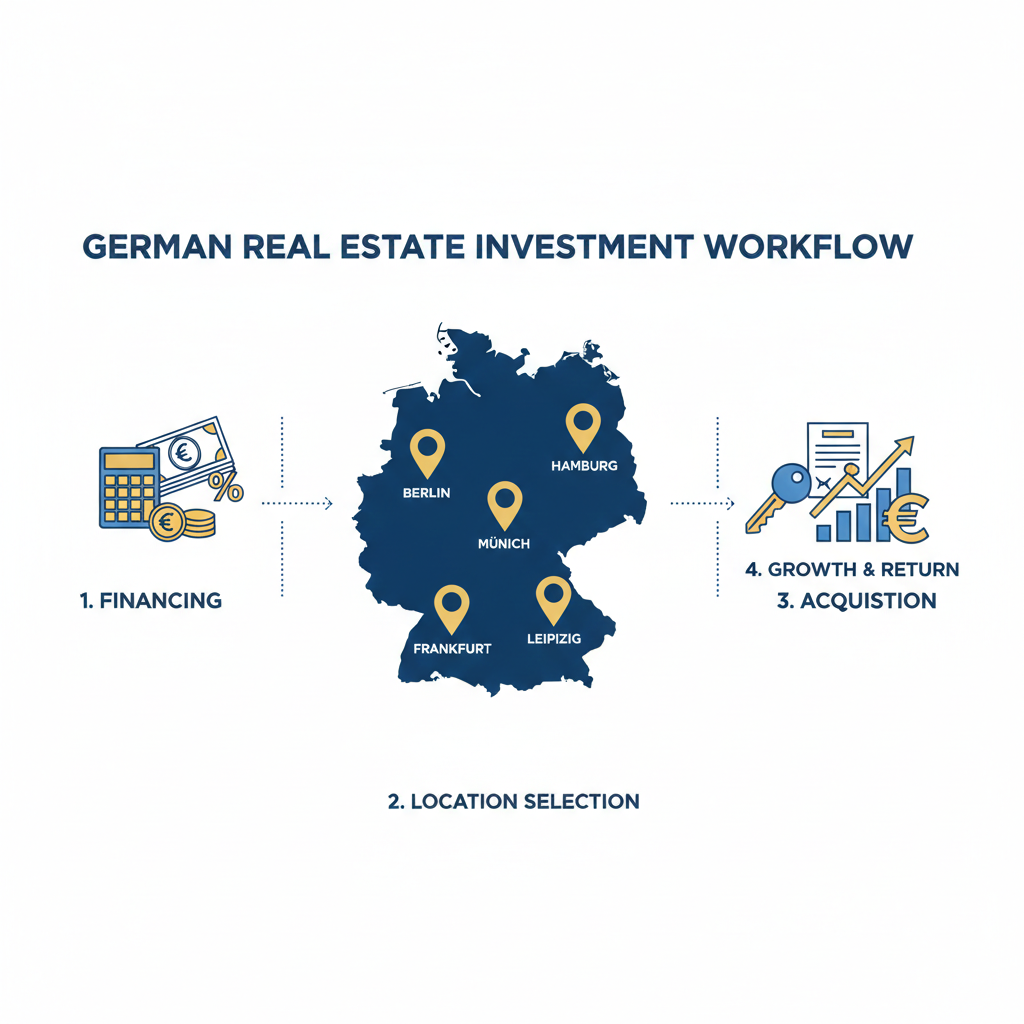
Germany remains one of Europe’s most stable real estate markets. The country combines economic strength, robust legal frameworks, and steadily growing demand for residential space, especially in metropolitan regions like Berlin, Munich, Hamburg, and Frankfurt.
Why Invest in German Real Estate Now?
Economic Stability: As Europe’s largest economy, Germany provides a solid foundation for long-term real estate investments. The German financial infrastructure continues to evolve, creating new opportunities for innovative financing solutions.
Regulatory Clarity: BaFin (Federal Financial Supervisory Authority) has established progressive frameworks supporting both traditional and modern financing forms. Over 90% of financial companies have already achieved MiCA compliance, making Germany a leading location for financial transparency.
Demographic Trends: With a population exceeding 83 million and continuous urbanization, demand for quality real estate remains consistently high.
Financing Options for Real Estate Investors
Traditional Bank Financing
The German banking landscape is diverse, offering various financing possibilities for property buyers:
Private Banks: Deutsche Bank, Commerzbank, and other leading institutions control nearly half of all German assets. They offer specialized real estate financing products for private and commercial investors.
Savings Banks (Sparkassen) and State Banks (Landesbanken): These public-law institutions are particularly attractive for regional real estate investments, often offering more favorable conditions for first-time buyers.
Cooperative Banks: With approximately 1,000 institutions nationwide, Raiffeisen banks provide personal consultation and flexible financing models.
Innovative Financing Solutions
The financial world is evolving rapidly. Modern technologies enable new pathways for real estate financing, from digital mortgages to blockchain-based solutions that simplify cross-border transactions.
Strategic Location Selection
Top Investment Locations 2026
Berlin: The capital remains a hotspot for investors. Despite rising prices, emerging districts like Lichtenberg and Marzahn-Hellersdorf still offer attractive entry opportunities.
Munich: Germany’s most expensive real estate market but also the most stable. Ideal for affluent investors seeking long-term appreciation.
Frankfurt: As Europe’s financial capital and home to the European Central Bank, Frankfurt offers excellent returns, especially for commercial real estate.
Hamburg: The port city combines high quality of life with increasing property values. HafenCity remains one of Europe’s most ambitious urban development projects.
Leipzig: The secret winner city offers the best price-performance ratio among German major cities, with growth rates exceeding Berlin’s.
Financial Planning and Budgeting
Understanding Additional Purchase Costs
For real estate investments in Germany, you must account for costs beyond the purchase price:
- Real Estate Transfer Tax (Grunderwerbsteuer): 3.5% to 6.5% depending on the federal state
- Notary Fees: approximately 1.5% of purchase price
- Land Registry Costs: approximately 0.5% of purchase price
- Broker Fees: 3% to 7.14% (regionally variable)
These additional costs quickly add up to 10-15% of the purchase price. Careful financial planning is therefore essential.
Equity Requirements
German banks typically require at least 20-30% equity for real estate financing. Some institutions also offer full financing, albeit at higher interest rates.
Rental Yield vs. Capital Appreciation
Yield Properties
For investors targeting cash flow, cities like Leipzig, Dresden, and Dortmund are attractive. Here you can achieve gross rental yields of 4-6%.
Calculation Formula: Gross Rental Yield = (Annual Net Rent / Purchase Price) × 100
With a purchase price of €200,000 and monthly net rent of €800: Annual Rent = €9,600 Yield = (9,600 / 200,000) × 100 = 4.8%
Appreciation Investments
In Munich, Hamburg, and Frankfurt, the focus is on long-term appreciation. Here rental yields are lower (2-3%), but annual appreciation can reach 5-8%.
Tax Aspects
Depreciation Opportunities
Rented properties can be depreciated linearly over 50 years at 2% per year. With a building value of €200,000, you can claim €4,000 annually for tax purposes.
Speculation Tax
Property sales are tax-free after a 10-year holding period. Sales within this period are subject to income tax on the profit.
Legal Framework Conditions
Rent Control (Mietpreisbremse)
Rent control applies in many German cities. Upon re-letting, rent may only be a maximum of 10% above the local comparative rent. Exceptions apply for:
- First occupancy after comprehensive modernization
- New constructions
- Existing rents above the permitted level
Energy Efficiency Requirements
Stricter energy standards have applied since 2023. An updated energy certificate must be available for sale or new rental. Investments in energy-efficient renovation can pay off through:
- Higher rents (up to 8% of modernization costs transferable)
- Government subsidies (KfW programs)
- Property appreciation
Digital Tools and Resources
Online Property Valuation
Modern platforms use AI-powered algorithms to estimate property values precisely. Use these tools to make informed purchasing decisions.
Financial Management
Professional financial management is crucial for successful real estate investments. Digital accounting tools and financial planning solutions can help you efficiently manage rental income, expenses, and returns.
PropTech: The Future of the Real Estate Industry
Germany has become a leading PropTech location. With over 203 PropTech companies, the country is driving digitalization of the real estate industry. Innovative solutions include:
- Digital Viewings: VR and 360° technology enables virtual property tours
- Smart Home Integration: Intelligent building technology increases comfort and efficiency
- Blockchain-based Land Registers: Faster and more secure property transfers
- AI-powered Tenant Management: Automated processes from tenant search to utility billing
Risk Management
Diversification
Distribute your real estate portfolio across various:
- Locations: Don’t put all eggs in one geographic basket
- Property Types: Combine residential, commercial, and mixed-use
- Price Segments: Luxury, middle-class, and entry-level properties
Liquidity Reserve
Maintain at least 10-15% of the property value as a liquidity reserve for:
- Unexpected repairs
- Rental defaults
- Interest rate changes
Future Trends 2026 and Beyond
Sustainability
ESG criteria (Environmental, Social, Governance) are becoming increasingly important. Properties with high energy efficiency standards achieve:
- Higher sales prices (10-20% premium)
- Better rentability
- Lower operating costs
Home Office Trend
The COVID-19 pandemic has permanently increased demand for properties suitable for home offices. Apartments with additional office space or flexible room concepts are particularly sought after.
Demographic Change
The aging society creates demand for:
- Barrier-free apartments
- Assisted living facilities
- Community-oriented housing projects
Practical Steps to Property Purchase
1. Financial Preparation
- Save equity capital (at least 20-30%)
- Obtain Schufa credit report
- Secure financing commitment
- Calculate budget including ancillary costs
2. Property Search
- Use online portals (ImmobilienScout24, Immowelt)
- Activate network (brokers, banks, personal contacts)
- Access off-market deals
- Regularly update search profiles
3. Due Diligence
- Conduct property viewings
- Inspect building structure (ideally with expert)
- Analyze energy certificate
- Review land register extract
- Study division declaration and protocols (for condominiums)
4. Purchase Processing
- Schedule notary appointment
- Review purchase contract (possibly with lawyer)
- Finally confirm financing
- Attend notary appointment
- Register property transfer in land register
5. Rental and Management
- Create professional photos
- Prepare exposé
- Conduct tenant credit checks
- Draft rental contract
- Organize caretaker and management services
Expert Tips for Successful Investments
1. Location, Location, Location: Location remains the most important criterion. Pay attention to infrastructure, transport connections, and development potential.
2. Think Long-term: Real estate is a long-term investment. Plan with a time horizon of at least 10-15 years.
3. Professional Advice: Utilize expertise from brokers, tax advisors, and financial experts. Costs amortize through better decisions.
4. Control Emotions: Make rational decisions based on numbers, not gut feeling.
5. Understand Market Cycles: Don’t buy blindly in overheated markets. Patience pays off.
Case Study: Successful Real Estate Investment in Leipzig
Initial Situation: Investor acquires an 80m² apartment in Leipzig-Plagwitz in 2021 for €180,000
Financing:
- Equity capital: €50,000
- Loan: €130,000 (1.5% interest, 30 years)
- Purchase ancillary costs: €25,000
Rental Income:
- Net rent: €750/month
- Annual net rent: €9,000
- Gross rental yield: 5%
Costs:
- Loan installment: €550/month
- Building maintenance: €150/month
- Maintenance reserve: €50/month
Cash Flow: +€50/month (after all costs)
Appreciation: After 5 years (2026), the apartment is worth approximately €230,000
- Return on equity: > 15% p.a.
- Total return including amortization and appreciation: > 20% p.a.
Conclusion
The German real estate market continues to offer attractive opportunities for smart investors in 2026. With careful planning, professional advice, and a long-term approach, you can benefit from the stability and growth potential of this market.
The combination of traditional financing methods and innovative digital solutions creates new pathways to real estate success. Use the available resources and tools to make informed decisions and strategically build your real estate portfolio.
Disclaimer: This article serves information purposes only and does not constitute financial or investment advice. Always consult qualified professionals before making real estate investments.
For further information on financial trends, smart investment strategies, and current market analyses, visit LumeChronos.de – your trusted partner for finance, health, and news content.