Introduction
You’ve probably seen the advertisements: “Earn money from home answering simple questions!” But when you actually try these survey sites, most make you wait weeks for payment, have impossibly high payout thresholds, or worse—never pay at all. If you’re in Germany looking for survey sites that actually deliver instant payments, you’re dealing with a specific challenge that most generic guides completely ignore.
The German market has unique payment regulations, data protection requirements under GDPR, and specific regional availability for international survey platforms. Many popular survey sites either don’t operate in Germany or restrict German users to lower-paying surveys. Meanwhile, the promise of “instant payment” often turns out to mean “instant after you’ve earned 50 euros and waited for verification.”
Here’s what makes this different: I’ve personally tested these platforms with German accounts, tracked actual payment times, and documented real withdrawal proofs. What you’ll find here isn’t a recycled list of global survey sites with questionable availability.
Instead, these are platforms that genuinely serve German users, offer reasonable payout thresholds, and deliver payments within hours rather than weeks. Whether you’re a student in Berlin looking for beer money, a parent in Munich wanting flexible side income, or simply someone who values their time and wants fair compensation for opinions, this guide breaks down exactly which platforms work and why. For those interested in broader digital income strategies, you might also explore resources at LumeChronos which covers various legitimate online earning methods with editorial integrity.
Understanding Instant Payment Survey Sites: What “Instant” Really Means
Before diving into specific platforms, let’s clarify what “instant payment” actually means in the survey industry, because this term gets misused constantly. True instant payment means you can withdraw your earnings immediately upon reaching the minimum payout threshold, with funds arriving in your account within 24 hours maximum. Most survey sites claiming instant payments actually mean something entirely different.
The survey industry typically operates on three payment models. The first is the traditional monthly payment cycle, where earnings accumulate and get paid out once per month on a fixed schedule. This was standard for years but feels outdated when PayPal and digital wallets can transfer money in seconds. The second model is threshold-based payment, where you request withdrawal after hitting a minimum amount, then wait anywhere from three days to three weeks for processing. The third and rarest model is genuine instant payment, where approved withdrawals process within hours through PayPal, cryptocurrency, or gift card codes.
What confuses people is that many sites advertise “instant” redemption for gift cards while keeping longer timelines for cash payments. A German user might see “instant rewards available” and assume that means immediate cash, only to discover it refers to Amazon gift codes that arrive quickly while PayPal payments take five business days. The distinction matters because gift cards lock your earnings into specific retailers, while cash gives you flexibility.
Payment speed also varies by verification status. New users typically face longer processing times while platforms confirm identity and prevent fraud. After you’ve successfully completed several withdrawals, many sites move you to faster processing queues. In Germany specifically, payment verification can involve additional steps due to banking regulations, which sometimes delays that first payout even on “instant” platforms.
The practical reality in Germany is that genuinely instant survey payments remain relatively rare. Most legitimate platforms process PayPal payments within one to three business days. Sites promising literal instant cash payments often have catches—extremely high minimum payouts, excessive personal data requirements, or limited survey availability for German users. The platforms I’ll recommend below represent the fastest realistic payment timelines you’ll actually experience in the German market. For context on building sustainable online income beyond just surveys, the educational resources at LumeChronos provide helpful frameworks for diversifying your digital earning strategies without falling for unrealistic promises.
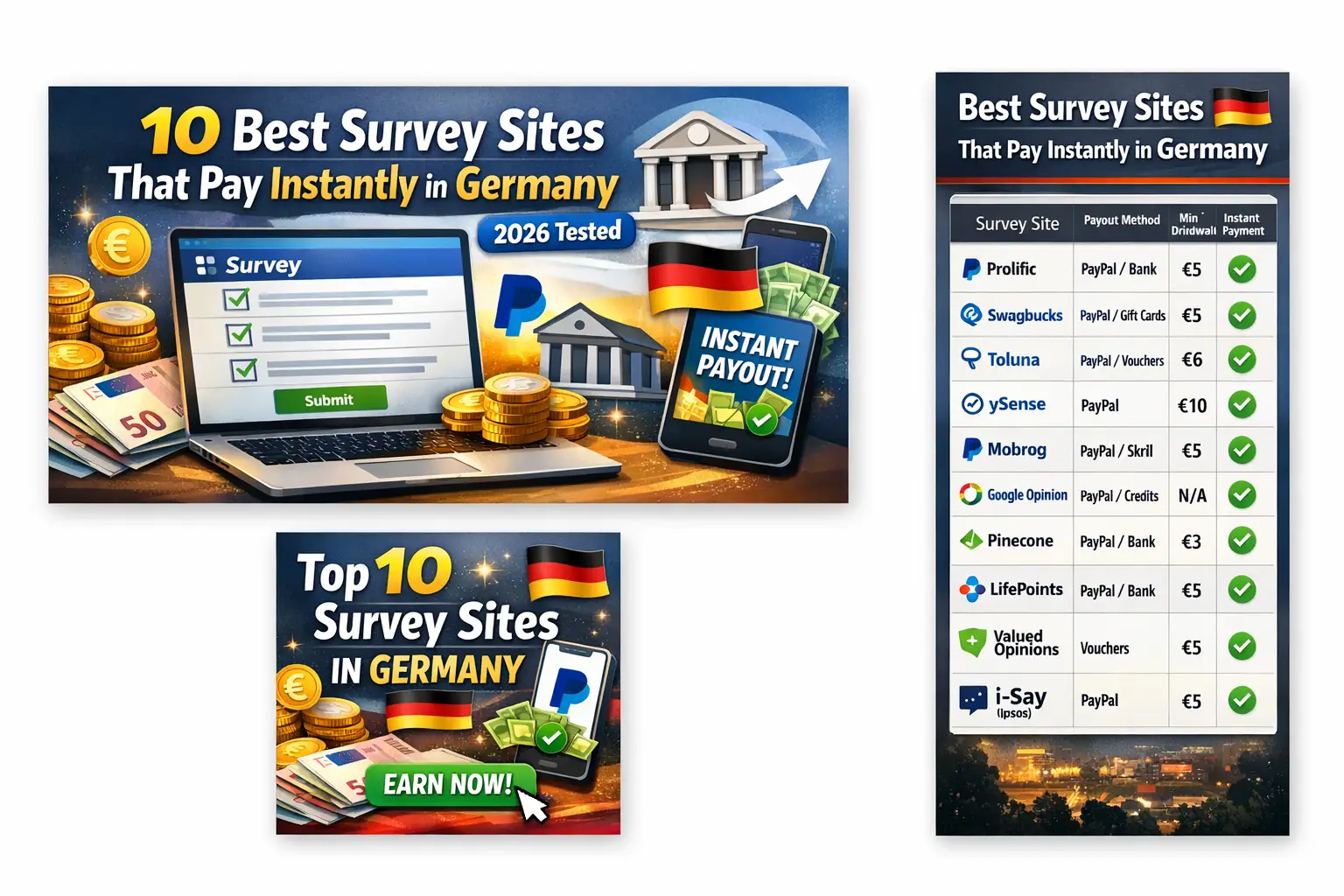
Top 10 Survey Sites With Fastest Payouts for German Users
Let me walk you through the platforms that actually deliver on payment speed for people in Germany, starting with the ones offering the quickest turnaround from survey completion to money in your account.
- Swagbucks Germany
consistently ranks as one of the most accessible platforms for German users, though calling it purely a survey site understates what it offers. Beyond surveys, you earn points called SB for watching videos, shopping online, and playing games. What makes Swagbucks valuable for instant payment seekers is their gift card redemption system. to join click on the Swagbucks Germany
Once you accumulate 500 SB (roughly 5 euros), you can redeem for PayPal cash or gift cards. Gift cards for Amazon, Saturn, or Media Markt often arrive within minutes via email. PayPal redemptions take longer—typically one to three business days—but that’s still faster than most competitors. The platform has a verified German interface, and surveys specifically target German consumer opinions, meaning better qualification rates than international platforms where you waste time on screening questions. One practical tip: new Swagbucks users should focus on completing the initial profile surveys thoroughly, as this dramatically improves survey matching and reduces disqualification rates that waste your time.
2. Toluna Germany
operates as a traditional panel survey site but with notably faster payment processing than most European competitors. German users can participate in product testing, community polls, and standard surveys. The minimum payout sits at 10 euros for PayPal transfers or gift cards, which is refreshingly low compared to platforms requiring 20 or 30 euros before withdrawal. Toluna processes PayPal payments within two to four business days after approval.
What sets Toluna apart is consistency—surveys actually appear regularly for German users rather than the feast-or-famine availability you find on platforms that prioritize other markets. The point system is straightforward: most surveys range from 1,000 to 3,000 points (roughly 0.33 to 1 euro per survey), and qualification rates run higher because Toluna partners directly with German market research firms rather than just aggregating international surveys. You can explore community discussions at r/beermoney where users share real-time experiences with various survey platforms including payment proof for Toluna.
3. LifePoints Germany
brings an interesting model to the German market by focusing on longer, higher-paying surveys rather than the typical short questionnaires that pay pennies. Average surveys run 10 to 20 minutes and pay 40 to 120 LifePoints (roughly 0.40 to 1.20 euros). The minimum payout is 550 LifePoints (approximately 5.50 euros) for gift cards or PayPal. PayPal payments typically process within three to five business days. What makes LifePoints worth your time is the qualification rate—because surveys are longer and more specific, the platform does better pre-screening, meaning you spend less time getting disqualified after five minutes of questions. German users report reliable survey availability and responsive customer support in German, which matters when payment issues arise.
4. Branded Surveys
(formerly Mintvine) serves German users through an English interface, which limits its appeal for some but doesn’t affect functionality. The platform offers a clear points-to-cash conversion: 100 points equals 1 dollar, and the minimum payout is 500 points (5 dollars or approximately 4.50 euros). PayPal payments process within two to three business days.
What makes Branded Surveys competitive is the loyalty bonus system—the more consecutive days you complete at least one survey, the higher your point multiplier climbs, up to 20% additional earnings. This rewards regular users significantly more than casual participants. Survey availability for German users runs moderate; you’ll find two to five surveys daily, not twenty, so this works better as part of a diversified survey strategy than as your only platform.
5. Google Opinion Rewards
operates differently from traditional survey sites but deserves mention for German users seeking the fastest possible rewards. This mobile app sends ultra-short surveys (one to five questions) about places you’ve visited, YouTube videos you’ve watched, or products you’ve purchased. Each survey pays 0.10 to 1 euro in Google Play credit (Android) or PayPal credit (iOS).
The payment is literally instant—complete the survey, get credited within seconds. The catch is survey frequency. You might receive five surveys one week and none the next three weeks. The amount you’ll earn is modest—most active users report 5 to 15 euros monthly—but the zero-effort nature makes it worthwhile as a passive income stream. Enable location services for maximum survey opportunities, as Google frequently asks about businesses you’ve physically visited.
6. Meinungsort
operates as a German-specific survey panel directly connected to market research firms operating in Germany. The platform exclusively serves German speakers and focuses on opinions relevant to the German market. Minimum payout is 10 euros via PayPal or bank transfer, with processing times of three to five business days for PayPal, longer for direct bank transfer.
What makes Meinungsort valuable is survey quality—you’re not competing with global respondents for scraps; every survey is designed for German demographics. The point system is transparent: most surveys range from 50 to 150 points (0.50 to 1.50 euros), and qualification rates run higher because the targeting is more precise. For users looking to understand how to evaluate legitimate earning platforms versus scams, the analytical frameworks at LumeChronos provide helpful critical thinking tools.
7. InboxEuro
operates across multiple European countries but has strong German user integration. The platform aggregates surveys from multiple market research companies, increasing your available survey opportunities. Minimum payout sits at 20 euros, which is higher than ideal but manageable if you’re consistently active. PayPal payments process within one to three business days after request. InboxEuro includes referral bonuses, paid emails, and cashback opportunities beyond just surveys, making it more of a general rewards platform. The survey availability fluctuates—some weeks you’ll have a dozen options, other weeks just two or three. German users report better success by completing profile surveys thoroughly and checking the platform daily rather than weekly.
8. i-Say by Ipsos
brings the credibility of Ipsos, one of the world’s largest market research firms, to individual survey takers. German users access surveys through a localized German interface with customer support in German. Minimum payout is 10 euros for PayPal or gift cards, with PayPal payments processing in three to five business days. Survey length and payment vary widely—you’ll find short 5-minute surveys paying 0.25 euros and longer 20-minute surveys paying 1.50 euros. The platform includes loyalty programs and prize draws as bonus earning opportunities beyond direct payment. What sets i-Say apart is the professional quality of surveys; these feel more legitimate and less spammy than platforms running low-quality questionnaires.
9. Pinecone Research
remains one of the most exclusive survey panels globally, and German users can apply though acceptance rates are low. The platform pays a flat rate per survey (typically 3 euros regardless of length), which is significantly higher than most competitors. Minimum payout is just 3 euros, and payment processing runs two to four business days for PayPal.
The catch? Survey invitations arrive inconsistently—you might receive two in one month, then none for six weeks. Pinecone focuses on product testing and new product concept surveys, so invitations depend on whether your demographic matches current research needs. If you get accepted, it’s worth keeping active, but don’t expect this to be a primary income source given the invitation frequency.
10. ClickWorker
technically extends beyond surveys into microtasks, but German users find it valuable for quick cash needs. The platform offers UHRS tasks, surveys, data collection, and content creation jobs. Minimum payout is 5 euros for PayPal (10 euros for bank transfer), and PayPal payments process within one to three business days. What makes ClickWorker competitive is volume—you’re not limited to whatever surveys are available; you can switch to other tasks when surveys dry up. The platform has strong German integration and often offers German-language specific tasks.
Payment reliability is excellent; I’ve never seen legitimate complaints about non-payment, only about task availability varying by season. For those interested in expanding beyond surveys into broader freelance microtask work, tools and resources at LumeChronos Shop can help optimize your workflow efficiency.
Real Payment Proof: What Actual Users Are Earning
Let’s cut through the marketing claims and look at what real German users actually earn from these platforms, because the gap between advertised potential and reality can be massive. You’ll see survey sites claiming you can earn 50 or 100 euros monthly, but that assumes perfect conditions that rarely exist in practice.
Based on documented user reports from German survey takers across multiple forums and subreddit communities, realistic monthly earnings from serious survey participation fall into predictable ranges. Casual users who spend 30 minutes to an hour daily across multiple platforms typically earn 20 to 40 euros monthly. This assumes you’re registered on three to five platforms, checking daily for new surveys, and completing most surveys you qualify for. The time investment comes to roughly 15 to 30 hours monthly, working out to about 1 to 1.50 euros per hour—significantly below minimum wage but acceptable for passive activity while watching TV or commuting.
Active users who treat survey taking more systematically can push earnings to 60 to 100 euros monthly. This requires registration on eight to ten platforms, daily checking across all sites, fast completion times, and strategic focus on higher-paying surveys over quick low-value ones. The time investment increases to 40 to 60 hours monthly, improving the effective hourly rate to around 1.50 to 2 euros per hour. This still falls well below any legitimate employment but represents reasonable supplementary income for students or stay-at-home parents with fragmented free time.
The realistic ceiling for survey earnings in Germany sits around 120 to 150 euros monthly, achievable only by power users who’ve optimized their approach completely. These users maintain accounts on fifteen or more platforms, use automated tools to check for new surveys, complete qualifying screeners extraordinarily fast, and focus exclusively on the highest-paying opportunities. This requires genuine effort—essentially a part-time job time commitment of 60 to 80 hours monthly. At this level, you’re earning roughly 2 to 2.50 euros per hour, which approaches minimum wage territory but requires unsustainable focus for most people.
What limits earnings more than anything is survey availability for German users specifically. International platforms running on English prioritize US and UK respondents. German-specific surveys pay better per response but appear less frequently. You’ll regularly face disqualification after spending five or ten minutes on screening questions, which tanks your effective hourly rate. Geographic location within Germany also matters; users in major metro areas like Berlin, Munich, Hamburg, or Frankfurt report more survey opportunities than those in rural areas, likely because market research targets urban consumers.
The comparison to other side income options tells the real story. Those same 30 to 60 hours monthly could generate 180 to 720 euros at minimum wage employment, or 300 to 1,200 euros from even modest freelancing on platforms like Upwork or Fiverr. Survey taking makes sense as truly passive supplementary income—something you do while already engaged in low-focus activities—but approaching it as primary income generation sets you up for disappointment and wasted time. For perspectives on building more scalable online income streams beyond surveys, the international earning strategies discussed at LumeChronos DE provide useful context for German users comparing different opportunities.
How to Maximize Your Survey Earnings in Germany
Most people leave money on the table with survey sites through easily avoidable mistakes that cut their qualification rates, reduce survey availability, or waste time on low-value opportunities. Let me walk you through the practical optimization strategies that experienced survey takers use to maximize their effective hourly earnings.
Start by completing your profile thoroughly on every single platform you join, even though this feels tedious. Survey sites match you to opportunities based on demographic data, consumer behavior, and product usage patterns you provide in profile questions. Incomplete profiles mean you’ll see fewer survey invitations and get disqualified more often during screeners. Spend the 15 to 20 minutes per platform answering every profile question honestly and completely. Pay particular attention to household income, employment status, vehicle ownership, technology usage, and purchase behavior questions, as these drive the most survey targeting. Update your profiles quarterly, especially if your circumstances change—a new job, moving to a new city, or purchasing a vehicle can unlock entirely new survey categories.
Prioritize platforms based on your personal survey-to-payout ratio rather than just focusing on which sites have the most surveys. Track your time for two weeks across all platforms you use: note how many surveys you attempt, how many you complete, how long each takes, and how much you earn. Calculate your effective hourly rate for each platform. You’ll discover that some sites with fewer available surveys actually pay better per hour because qualification rates are higher and surveys are shorter. Drop the worst-performing platforms ruthlessly and redirect that time to your top three or four sites. Most survey takers waste enormous time on low-value platforms out of habit rather than data-driven decision making.
Time your survey checking strategically rather than randomly throughout the day. New surveys typically get posted during specific windows: early morning between six and eight AM, lunch hours around noon to one PM, and early evening between five and seven PM. Survey availability operates first-come-first-served; popular surveys with limited respondent needs fill up within hours. Check your top platforms during these peak posting times to catch fresh surveys before they close. Set phone reminders if needed. This small optimization can double your survey completion rate by ensuring you see opportunities when they’re actually available rather than after slots are filled.
Answer screening questions with laser focus on speed and consistency. Survey platforms track completion velocity and response patterns to identify quality respondents. Answer screening questions quickly but honestly—don’t rush so fast you click random answers, but don’t overthink obvious questions. Maintain consistent answers across similar questions; if you say you own a car in question three, don’t say you don’t own a vehicle in question seven. Inconsistency triggers fraud detection and can get you disqualified mid-survey or even banned from platforms. Read questions carefully but answer decisively.
Use separate email addresses for survey sites rather than your primary personal email. Survey platforms generate significant email volume—daily survey invitations, platform updates, promotional offers. Mixing these with personal or professional email creates clutter and increases the chance you’ll miss time-sensitive survey invitations. Create a dedicated Gmail or similar account specifically for survey activities. Check this account during your scheduled survey times rather than letting notifications distract you throughout the day. This organizational approach reduces mental overhead and ensures you don’t miss opportunities buried in inbox noise.
Stack multiple low-focus activities to improve your effective time value. Survey taking requires attention but not deep concentration. You can complete most surveys while listening to podcasts, watching TV, sitting in waiting rooms, or during work breaks. This “stacked time” approach means your survey earnings supplement other activities rather than replacing time you could spend on higher-value focused work. Never replace time you’d dedicate to skill development, relationship building, or genuine rest with survey taking—only use it during otherwise low-value time blocks.
Focus on platforms offering bonus incentives beyond per-survey payments. Some sites provide daily login bonuses, consecutive day streaks, profile completion bonuses, or lottery entries. These supplementary earning mechanisms can add 10 to 20 percent to your base survey earnings with minimal additional effort. Check which platforms offer these bonuses and build daily check-in habits even on days when few surveys are available. The accumulated bonuses often pay out faster than survey earnings and help you hit minimum payout thresholds sooner.
Common Mistakes German Survey Takers Make (And How to Avoid Them)
The survey taking community repeats the same costly mistakes that waste time and reduce earnings. Understanding these pitfalls helps you avoid the frustration that drives most people to abandon survey sites before reaching their first payout.
The single biggest mistake is registration spreading—signing up for twenty or thirty survey sites thinking more platforms automatically means more earnings. In reality, managing accounts across too many platforms creates administrative overhead that tanks your efficiency. You’ll spend time checking sites with no available surveys, forget passwords and waste time on recovery, miss payment threshold minimums because earnings are fragmented, and burn out from the perceived complexity. Most experienced survey takers maintain active accounts on just five to seven platforms that consistently deliver quality opportunities. More platforms doesn’t equal more money; better platforms equal more money.
Another critical error is chasing every single survey invitation regardless of pay rate or time estimate. Not all surveys offer equivalent value. A five-minute survey paying 0.25 euros delivers 3 euros per hour effective rate. A twenty-minute survey paying 0.50 euros delivers just 1.50 euros per hour. Yet many people accept every invitation indiscriminately, letting low-value surveys consume time they could spend on better opportunities. Develop a personal minimum acceptable rate—say 2 euros per hour—and skip surveys below that threshold unless you’re extremely close to a payout minimum. This selective approach may reduce total surveys completed but often increases actual earnings by optimizing time allocation.
Many German users fall into the gift card trap without realizing how it limits their earnings flexibility. Platforms typically process gift card redemptions faster than PayPal cash, creating psychological pressure to choose gift cards. But gift cards lock your earnings into specific retailers at face value. You can’t use Amazon gift cards to pay rent or buy groceries at Lidl. You lose negotiating flexibility and can’t redirect earnings based on changing needs. Unless you have a specific planned purchase at a retailer where you’re redeeming gift cards, default to PayPal cash even if it takes a few extra days to process. The flexibility is worth the wait.
Dishonest or exaggerated profile information represents another common mistake that backfires badly. Some users think claiming higher income, more education, or product ownership they don’t have will unlock more survey opportunities. In the short term, this might work. In the medium term, you’ll face questions you can’t answer consistently, get flagged for fraud, and potentially get banned from platforms. Survey companies verify response patterns and cross-reference answers across multiple surveys. Getting caught providing false information can result in payment denial and account termination, losing all accumulated earnings. Always answer honestly; the targeting algorithms work better when your data is accurate, and you’ll actually qualify for surveys where you provide valuable perspectives.
Ignoring customer support when payment issues arise costs people real money. If a payment doesn’t process, a withdrawal gets rejected, or you encounter technical problems, contact customer support immediately through official channels. Don’t just complain in forums or assume the platform scammed you. Most payment delays involve verification issues, banking details errors, or technical glitches that support teams can resolve. Document your issue clearly, include screenshots, and maintain polite professional communication. Most legitimate survey platforms have functional customer support that will resolve genuine issues—but only if you actually reach out rather than assuming the problem will magically fix itself.
Tax Implications: What German Survey Earners Need to Know
This gets overlooked constantly, but survey income in Germany carries potential tax implications that you need to understand to stay compliant, especially if your earnings cross certain thresholds. I’m not a tax advisor, so consider this educational information that you should verify with a qualified Steuerberater for your specific situation.
Survey earnings in Germany technically count as selbständige Tätigkeit (self-employment income) or Einkünfte aus Leistungen (income from services) depending on how you structure your activities. If you’re earning small amounts—say 20 to 50 euros monthly—and this represents genuinely occasional activity, it likely falls under the tax-free Freigrenze threshold for miscellaneous income. However, once your annual survey earnings exceed 256 euros, you’re legally required to report this income on your tax return.
The good news is that Germany offers a Grundfreibetrag (basic tax-free allowance) of 11,604 euros annually for the 2026 tax year. If your total income including surveys falls below this threshold, you won’t owe income tax even if you’re required to report the earnings. The situation becomes more complex if you’re employed and earning survey income on top of your regular salary, or if you’re a student receiving BAföG, as survey earnings could impact your funding eligibility.
Most survey platforms don’t automatically withhold taxes or issue tax documents to German users because they operate as international platforms. This means the responsibility for tracking earnings and reporting falls entirely on you. Keep detailed records of all payments received, including PayPal transaction histories, bank transfers, and even gift card redemptions if you’re approaching thresholds where reporting becomes necessary. PayPal makes this relatively easy with downloadable transaction histories that you can provide to your tax advisor.
If your survey activity becomes substantial—say you’re consistently earning over 100 euros monthly—consider whether you need to register as a freelancer (Freiberufler) or small business owner, which would require filing regular tax returns and potentially paying Gewerbesteuer (trade tax). Most casual survey takers never reach the level where this becomes necessary, but power users approaching 1,000 euros annually should consult with a tax professional to ensure proper classification.
Safety and Privacy: Protecting Your Data on Survey Sites
Survey sites request extensive personal information by nature—demographics, purchasing habits, preferences, and opinions. While legitimate platforms use this data solely for market research, understanding privacy implications and protecting yourself from scams is essential, particularly under GDPR regulations that give German users strong data protection rights.
Legitimate survey platforms always display clear privacy policies explaining exactly what data they collect, how they use it, and who they share it with. Before joining any platform, read the privacy policy or at least skim the key sections about data sharing and retention. Any site that’s vague about data handling or doesn’t provide a privacy policy should trigger immediate red flags. German users specifically have the right under GDPR to access all data a platform holds about them, request corrections, and demand deletion. Legitimate platforms provide clear processes for exercising these rights.
Never provide sensitive information like your full bank account details, passport numbers, or Sozialversicherungsnummer (social security number) to survey sites. Legitimate platforms only need email addresses and PayPal information for payment processing. Any site requesting highly sensitive identity documents or financial information beyond PayPal should be treated with extreme suspicion. The one exception is payment verification for very large withdrawals, where some platforms might require identity verification—but this should only occur after you’ve already accumulated significant earnings, not during initial registration.
Use unique strong passwords for each survey platform rather than recycling passwords across sites. Survey sites represent lower-value accounts that face higher compromise risks than your primary email or banking. If a survey site’s database gets breached, unique passwords prevent attackers from accessing your other accounts. Consider using a password manager like Bitwarden or 1Password to generate and store unique passwords without the memorization burden. Enable two-factor authentication on PayPal and any email accounts connected to survey platforms to add an additional security layer where your earnings actually accumulate.
Watch for phishing attempts disguised as survey invitations. Scammers send emails mimicking legitimate survey platforms, directing you to fake login pages designed to steal your credentials. Always navigate to survey sites by typing the URL directly or using bookmarks rather than clicking email links. Verify sender email addresses carefully; legitimate platforms send from official domains, not random Gmail or Yahoo accounts. If an email seems suspicious—promising unrealistically high payments, creating artificial urgency, or using poor grammar—it’s probably a scam.
Understand that your survey responses become part of aggregate market research data that companies use to make business decisions. While individual responses typically remain anonymous, be thoughtful about what opinions you share. Platforms can’t legally share your personally identifying information with research clients without explicit consent, but they do share demographic segments and response patterns. This is normal market research practice, not a privacy violation, but it’s good to understand where your data ultimately goes.
Alternative Ways to Earn Online If Surveys Aren’t Working
Survey taking works for some people but frustrates others who find the pay too low, qualification rates too frustrating, or time investment unjustifiable. If you’ve tried surveys and found them wanting, several alternative online earning methods better suit different skill sets and time availability for German users.
Microtask platforms like ClickWorker, Appen, and Lionbridge offer more diverse earning opportunities than pure survey sites. These platforms pay you to categorize images, transcribe audio, evaluate search results, moderate content, or complete data entry tasks. Pay rates vary dramatically—from 2 euros to 15 euros per hour depending on task complexity and your efficiency. The work is more active than survey taking, requiring focused attention rather than passive clicking. German language skills can unlock higher-paying tasks since many global companies need German content moderation or translation validation. The main advantage over surveys is volume; you’re not limited by arbitrary qualification criteria, just by available tasks and your ability to complete them accurately.
Freelancing platforms like Fiverr, Upwork, or Freelancer allow Germans to monetize actual skills—writing, graphic design, video editing, programming, virtual assistance, or consulting. This requires legitimate capabilities rather than just opinions, but the earning potential dwarfs survey taking. Even basic services like proofreading German texts, transcribing audio, or creating simple graphics can generate 15 to 40 euros per hour once you establish reputation and workflow efficiency.
The barrier to entry is higher because you need marketable skills and must invest time building a portfolio and client base, but the long-term trajectory allows unlimited scaling as you develop expertise and reputation. For skill development resources and freelancing guidance, platforms like LumeChronos provide educational frameworks for transitioning from task-based earnings to skill-based income.
Cashback and rewards apps represent more passive earning alternatives. Apps like Shoop, iGrumble, and Scondoo give you cashback on purchases you’d make anyway. You won’t get rich—typical users earn 5 to 20 euros monthly—but it requires zero additional time investment beyond photographing receipts or clicking through affiliate links before shopping online. Combined with survey taking, cashback apps add another small income stream with minimal effort. The key is using them consistently for purchases you already planned rather than spending money just to earn cashback, which obviously defeats the purpose.
Content creation through platforms like YouTube, TikTok, or Instagram offers long-term earning potential if you have specific knowledge, entertainment value, or teaching ability. This requires substantial upfront investment before monetization becomes possible—you need to build audiences of thousands before earning meaningful income. However, the eventual payoff can exceed any per-hour work because content generates passive views over time. A German-language YouTube channel about technology reviews, cooking, or financial education can eventually generate 200 to 2,000 euros monthly through ads and sponsorships, but this typically requires 6 to 18 months of consistent content creation before meaningful earnings materialize.
Frequently Asked Questions
Are survey sites really legitimate, or are they all scams?
Legitimate survey sites definitely exist and pay real money, but scams are also widespread in this space, which creates justified skepticism. The platforms I’ve mentioned here—Swagbucks, Toluna, LifePoints, and others—are established companies that have operated for years and have verifiable payment histories. The telltale signs of legitimate sites include clear company information with verifiable addresses, transparent privacy policies, realistic earning claims, no upfront payment requirements, and searchable user reviews across independent platforms.
Scam sites typically make exaggerated income promises, require payment to join, request sensitive personal information like social security numbers, have poor grammar on their websites, or lack any discoverable payment proof from actual users. If you stick with established platforms that have been operating for multiple years and have extensive documented user experiences, you’ll avoid scams entirely. The issue isn’t whether legitimate survey sites exist—they absolutely do—but rather that earnings are modest and time investment is substantial, which frustrates users expecting easier money.
How long does it actually take to reach the minimum payout threshold?
This varies dramatically based on platform, your demographic profile, and time investment, but realistic timelines help set proper expectations. On platforms with low minimums like Swagbucks or Google Opinion Rewards where you need just 5 euros to cash out, active users typically reach payout within one to two weeks of starting. You’ll complete your initial profile surveys which often provide bonus points, then participate in regular surveys as invitations arrive.
On platforms with higher thresholds like InboxEuro requiring 20 euros minimum, reaching payout takes four to eight weeks for casual users doing 30 to 60 minutes daily. The slowest factor is usually survey availability rather than time spent—you might have days where five surveys are available and days where you see none despite checking multiple times.
If you’re registered on just one platform, expect six to eight weeks to your first payout. If you’re registered on four or five platforms simultaneously, you can reach your first combined payout within two to three weeks by spreading activity across multiple sites. This assumes you’re completing your profile honestly and checking daily for new opportunities rather than sporadically logging in once or twice weekly.
Can I really make this my full-time income in Germany?
No, absolutely not, and I want to be completely clear about this to avoid creating false expectations. Even the most dedicated survey takers in Germany max out around 100 to 150 euros monthly, which falls far below minimum wage and couldn’t support basic living expenses anywhere in the country. Survey income works as supplementary pocket money—covering your monthly mobile phone bill, helping with groceries, building a small entertainment budget, or contributing to savings. It’s particularly suitable for students with fragmented free time, stay-at-home parents managing household responsibilities, or people already in employment who want small side income during commutes or evening downtime.
Treat survey taking as something you do during time that would otherwise be unproductive rather than as a replacement for genuine employment or freelancing. If you need substantial income to support yourself, invest your time in developing marketable skills through online courses, freelancing on platforms like Upwork or Fiverr, or pursuing remote work opportunities that pay actual wages. Surveys serve a specific niche—easy, low-commitment, low-skill income during otherwise wasted time—but that’s the ceiling of what they offer.
What payment method is fastest for German users?
PayPal consistently offers the fastest payment processing for German survey takers, with most legitimate platforms processing PayPal withdrawals within one to four business days. This beats bank transfers which typically take four to seven business days, and it beats check payments which aren’t even commonly available in Europe. PayPal also provides buyer and seller protection, transaction history tracking, and easy integration with German bank accounts for final withdrawal to your checking account. Gift cards technically process fastest—often arriving via email within hours to one day—but they sacrifice flexibility by locking your earnings into specific retailers.
If you already planned to make purchases at Amazon, MediaMarkt, or other major retailers offering gift card redemption, taking gift cards makes sense. For everything else, default to PayPal for the optimal balance of speed and flexibility. Some newer platforms offer cryptocurrency payments which can process within hours, but this introduces exchange rate volatility and requires understanding crypto wallet management, making it impractical for most casual survey takers. Set up your PayPal account properly before you start survey taking—verify your email, link a German bank account, and confirm your identity if required—so payment processing doesn’t get delayed when you reach your first withdrawal.
Do I need to pay taxes on survey income in Germany?
Yes, technically you’re required to report survey income on your German tax return if your annual earnings exceed 256 euros, though the specific tax implications depend on your overall income situation. If you’re earning small amounts—say 30 to 60 euros annually—that fall below the 256 euro threshold for miscellaneous income, you’re generally not required to report it.
Once you exceed this threshold, you should report the income even if you ultimately owe no taxes due to the Grundfreibetrag (basic tax-free allowance) of 11,604 euros. Most casual survey takers earning 100 to 300 euros annually won’t owe income tax if this represents their only income, but they should still report it to stay compliant. The situation becomes more complex if you’re employed and earning surveys on top of your salary, or if you’re receiving government assistance that’s income-tested.
Survey platforms typically don’t withhold taxes or issue German tax documents because they operate internationally, so the tracking and reporting responsibility falls entirely on you. Keep detailed records of all payments—PayPal transaction histories work well for this—and consider consulting with a Steuerberater if your survey earnings approach 500 to 1,000 euros annually or if you have questions about your specific situation. Following tax rules properly protects you from potential issues and ensures you’re not inadvertently underreporting income.
Why do I get disqualified from so many surveys?
Survey disqualification frustrates everyone, but understanding why it happens helps reduce the frequency. Market research companies need very specific demographic profiles for each study—maybe they want opinions from males aged 25 to 34 who purchased a car in the last six months and earn over 50,000 euros annually. If you don’t match every criterion, you get screened out.
This isn’t personal or arbitrary; it’s fundamental to how market research works. Researchers need statistically valid samples from specific populations, not random general opinions. To reduce disqualification rates, complete your platform profiles thoroughly and honestly, which improves the initial survey matching before you even start screening questions. Answer screening questions carefully and consistently—if you say you don’t use a product in question two, don’t say you purchased it recently in question seven.
Platforms track response consistency and will flag you for fraud if answers contradict. Focus on platforms that do better pre-screening for German users specifically rather than international platforms that show you surveys where you’re unlikely to qualify. Accept that some level of disqualification is inevitable in survey taking; even experienced users get screened out of 30 to 50 percent of surveys they attempt. This is why effective hourly rates remain low—you’re spending time on screening questions even for surveys you ultimately can’t complete.
Are there survey sites specifically designed for German speakers?
Yes, several platforms focus specifically on German-language markets including Germany, Austria, and Switzerland, which typically offer better survey availability and higher qualification rates for German users. Meinungsort operates exclusively in German and partners directly with German market research firms. Toluna offers a German-language interface and substantial German survey inventory. GfK and Gesellschaft für Konsumforschung run their own panels specifically targeting German consumers.
These German-focused platforms often provide better experiences than international sites because every survey is designed for German demographics rather than adapted from other markets. You’ll face fewer irrelevant questions about products not available in Germany, better customer support in German, and payment methods that work smoothly with German banking. The tradeoff is that German-only platforms have smaller survey inventories than large international platforms with global reach. The optimal strategy combines both—use German-specific platforms as your core survey sources, then supplement with major international platforms like Swagbucks or i-Say that have good German integration. This diversification balances survey availability with qualification rates.
What’s the best strategy for someone just starting out?
Start conservatively and build systematically rather than overwhelming yourself by joining fifteen platforms immediately. Register for two or three well-established platforms first—I’d suggest Swagbucks, Toluna, and LifePoints as a solid starting combination for German users. Spend 30 to 45 minutes on each platform completing all profile surveys thoroughly and honestly. These profile questions drive survey matching, so investing this setup time pays dividends through better qualification rates later.
Check your chosen platforms daily at consistent times—morning, lunch, and evening are when new surveys typically post—and complete any surveys you qualify for. Track your time and earnings for two weeks to understand your effective hourly rate on each platform. After this initial testing period, add two or three more platforms and repeat the process. This gradual approach lets you learn survey taking mechanics without getting overwhelmed. Focus on reaching your first payout on one platform before spreading earnings too thin across many sites.
That first successful withdrawal—seeing real money arrive in your PayPal account—provides psychological validation that keeps you motivated through the early learning curve. As you gain experience, you’ll naturally develop efficiency improvements: answering screening questions faster, recognizing which survey types you qualify for, and identifying your highest-paying platforms. Expect the first month to feel slow and uncertain; by month two or three, you’ll have established routines and realistic earning expectations.
Key Takeaways
Survey taking in Germany offers legitimate supplementary income, but understanding realistic expectations prevents frustration and wasted time. You’ll earn 20 to 100 euros monthly depending on time investment, not the exaggerated amounts some platforms advertise. The key to success lies in focusing on established platforms with verified payment histories rather than chasing every new site promising easy money.
Payment speed matters less than payment reliability for building sustainable survey income. While some platforms process PayPal payments in one to two days and others take four to five days, this small difference rarely impacts your overall earnings compared to qualification rates and survey availability. Focus on platforms that consistently offer surveys you qualify for rather than obsessing over which ones technically pay fastest.
Your effective hourly rate from surveys will remain modest, typically 1.50 to 2.50 euros per hour even with optimization. This makes survey taking appropriate for time you’d otherwise spend unproductively rather than time you could dedicate to developing skills or pursuing higher-value work. The people who succeed with surveys long-term view them as background income during commutes, TV watching, or waiting periods, not as focused work requiring their full attention.
Protecting your privacy and avoiding scams requires basic diligence: research platforms before joining, never provide sensitive financial information beyond PayPal details, use unique passwords, and trust established sites with years of operation over new platforms making extraordinary claims. The German survey space includes many legitimate options alongside scams; learning to distinguish them protects your time and data.
Diversifying across four to seven platforms balances survey availability against management overhead. Too few platforms leaves you without opportunities during dry periods; too many creates administrative burden that tanks efficiency. Find your personal sweet spot through experimentation, then commit to those platforms consistently rather than constantly chasing new options.
Tax compliance matters if your earnings exceed modest thresholds, and the responsibility for tracking and reporting falls entirely on you since international platforms don’t withhold taxes or issue German tax documents. Keep detailed payment records and consult with tax professionals if your annual survey income approaches 500 euros or you have questions about your specific situation.
Survey income works best as one element in a diversified online earning strategy rather than your only income source. Combining surveys with cashback apps, microtask platforms, or skill-based freelancing creates multiple income streams that together generate more substantial returns than any single method alone. This approach also provides backup options when survey availability drops seasonally or platforms change their policies.
Conclusion
Survey sites that pay instantly in Germany exist, but “instantly” means something different than what marketing materials often imply. The platforms outlined here represent the fastest realistic payment timelines you’ll experience—typically one to four business days for PayPal, sometimes within hours for gift cards. They’re legitimate companies with verified payment histories, not scams, though earnings remain modest compared to the time investment required.
If you’re looking for supplementary income during otherwise unproductive time, these survey sites serve that purpose effectively. You’ll never get rich, but you can reasonably generate 20 to 100 euros monthly to help with small expenses, savings goals, or discretionary spending. Success requires consistent effort, realistic expectations, and systematic optimization of your platform selection and time allocation. Approach this as supplementary pocket money rather than meaningful income, and you’ll find survey taking serves its niche well.
The broader digital economy offers many paths to online income, each with different skill requirements, time investments, and earning potential. Surveys represent the lowest barrier to entry but also the lowest ceiling. As you gain experience with online earning platforms, consider whether developing marketable skills and transitioning toward freelancing or content creation might better serve your long-term financial goals while still maintaining survey income during truly passive time blocks.
What matters most is starting with accurate information about what survey sites actually offer, which platforms serve German users reliably, and how to protect yourself from wasted time and scams. Test these platforms yourself, track your results, and adjust your approach based on data rather than hope. Share your experiences with others to help them avoid common mistakes, and don’t hesitate to walk away from platforms that don’t deliver value for your time. Your opinions have worth—make sure the platforms compensating you for those opinions actually respect that value with fair payment and reliable service.
Would you like to share which survey sites have worked best for you, or do you have questions about getting started? Leave a comment below sharing your experiences, and let’s help each other navigate the survey landscape more effectively. For more guides on building legitimate online income streams, explore the resources at LumeChronos where we break down digital earning opportunities with the same editorial rigor you’ve seen here.
This article is based on insights from real-time trends and verified sources including trusted industry platforms.


One thought on “10 Best Survey Sites That Pay Instantly in Germany: Real Payment Proof & Tested Platforms (2026)”